RICS Level 3 Surveys

Book in your RICS Level 3 Building Survey

RICS regulated surveyors nationwide
Most paid £645 to £775, middle price £685 (prices checked November 2026)
Report usually 5 to 7 working days after the visit
RICS Regulated
Regulated
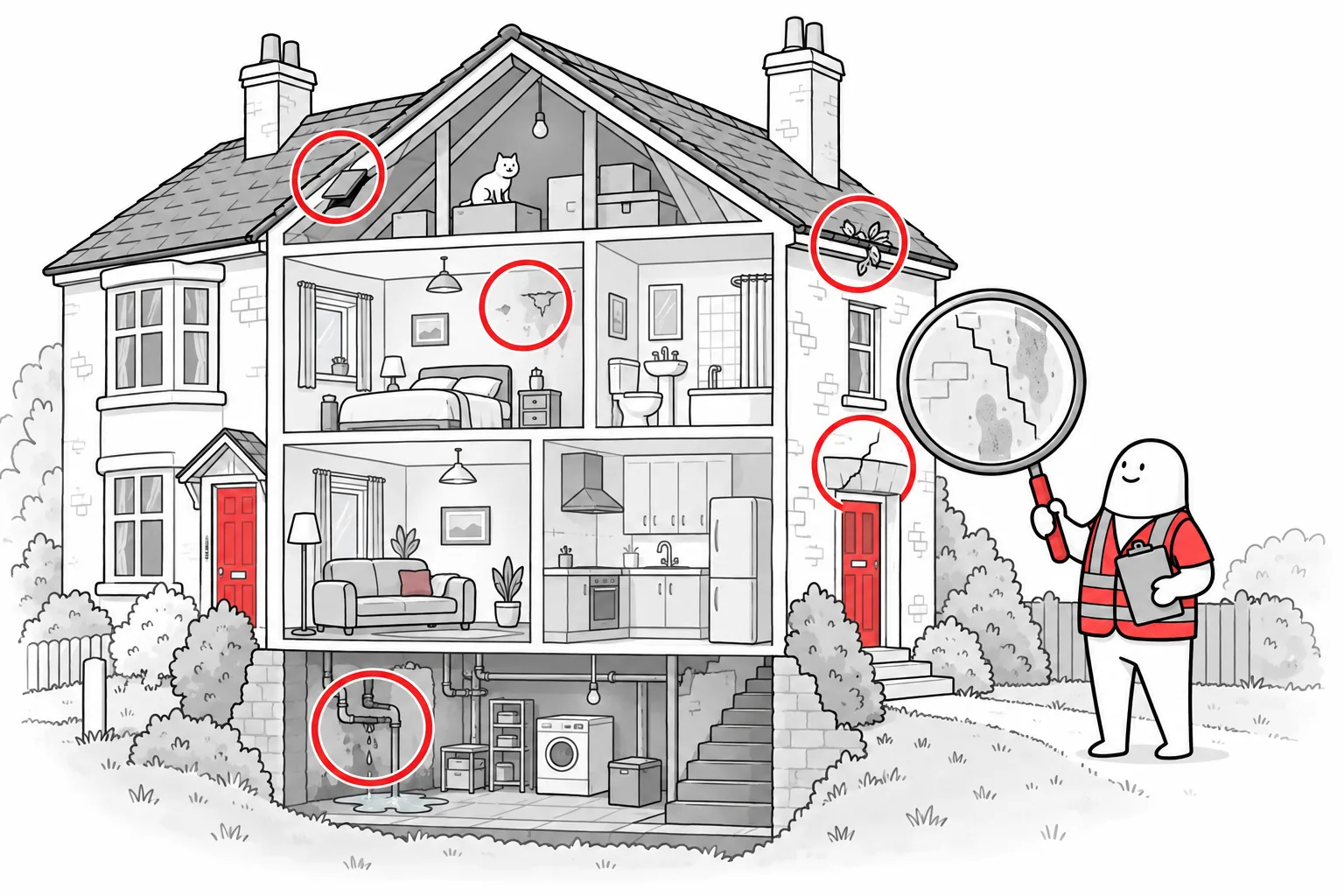
A Homie surveyor with a magnifying glass and clipboard beside a cutaway older house, with a slipped roof slate, a blocked gutter, damp, a cracked lintel and a leaking pipe circled in red

The short answer

Level 3 survey in 30 seconds

  • What it is: a RICS Home Survey Level 3, once called the Building Survey, the most detailed of RICS’s three home surveys, written for you as the buyer.
  • What’s inspected: the inside and outside of the home and all its permanent outbuildings, including the roof space where it is safe, as far as they can be reached.
  • What you get: a condition rating for each part, the most probable cause of each defect, repair options and risks, with cost estimates only where agreed.
  • Price: Most paid £645 to £775 through Homemove in the twelve months to 31 October 2026.
  • Report: usually 5 to 7 working days after the visit, online in your Homemove dashboard.

4.6/5 from 291 reviews on Trustpilot · surveys by independent RICS-regulated firms

A Homie surveyor in a red hi-vis vest shining a torch

Your price in 20 seconds

What will a Level 3 survey cost for your home?

Pick the home’s value and type, and find the address. You’ll see the Level 3 price next to a Level 2 for the same home, and the address carries straight into your booking.

Last reviewed · prices paid in the twelve months to 31 October 2026

Cost

How much does a Level 3 survey cost?

Homemove customers paid a middle price of £685 in the twelve months to 31 October 2026, and most paid £645 to £775. The home’s value moves the price most, then its size and where it is. Enter the address and the price for that home shows before you book.

Level 3 price by the home’s value, twelve months to 31 October 2026. Prices checked November 2026.
Home valueMiddle priceMost paid
Up to £200,000£695£645 to £695
£200,001 to £300,000£695£645 to £695
£300,001 to £500,000£725£700 to £770
£500,001 to £1 million£949£895 to £995

Level 3 surveys in London had a median of £845, £170 more than the £675 typical of other regions. The middle half paid £725 to £949 in London, against £645 to £695 in Yorkshire and the Humber. London homes are worth more, so more of them sit in higher price bands, and travel and parking cost surveyors more there.

See Level 3 survey costs by region

What the price includes

  • The RICS Level 3 inspection and report by an independent RICS-regulated firm covering your postcode.
  • Arranging access with the occupier and booking the visit.
  • Your report online in your Homemove dashboard.

It doesn’t include a market valuation or an insurance rebuild (reinstatement) figure: RICS treats those as extra services under separate terms (RICS’s Level 3 description). If you need one, tell us before you book.

Your dashboard

Book it, track it and read it in one place

Everything after you book happens in your Homemove dashboard. These are the real screens, with personal details left out.

  1. See your price, then book

    Your quote shows a fixed price, VAT included, before you pay. Pay online and the booking is made.

  2. Track every step

    Follow your survey from payment to a surveyor taking the job, the visit date and the report, without chasing anyone.

  3. Read your report online

    The report arrives in your dashboard, usually 5 to 7 working days after the visit, with a plain-English summary of what each rating means.

Get your price

Who it’s for

Is a Level 3 right for this home?

RICS points these homes to a Level 3. A conventional home in reasonable condition usually needs only a Level 2.

  • Older, listed or period homes. Over about 100 years old, listed, or built in a way that has since changed, such as many Victorian and Edwardian houses.
  • Unusual construction. Timber frame, thatch, concrete or other non-standard building methods and materials.
  • Altered, extended or run-down homes. Loft conversions, removed walls, big extensions, or a home in poor condition.
  • Major works ahead. You plan to renovate, extend or convert, and want to know the condition and the likely causes of defects first.

“Building survey”, “structural survey” and “RICS Home Survey Level 3” mean the same survey. RICS renamed the Building Survey as Level 3 when its Home Survey Standard came in on 1 March 2021.

The surveyors we work with

Every Level 3 is done by an independent RICS-regulated firm that covers your postcode, working for you, not the agent or the seller. Under RICS’s terms the surveyor is an AssocRICS, MRICS or FRICS member. The firm’s name shows on your dashboard, so you can check it on RICS Find a Firm and the surveyor on RICS Find a Member.

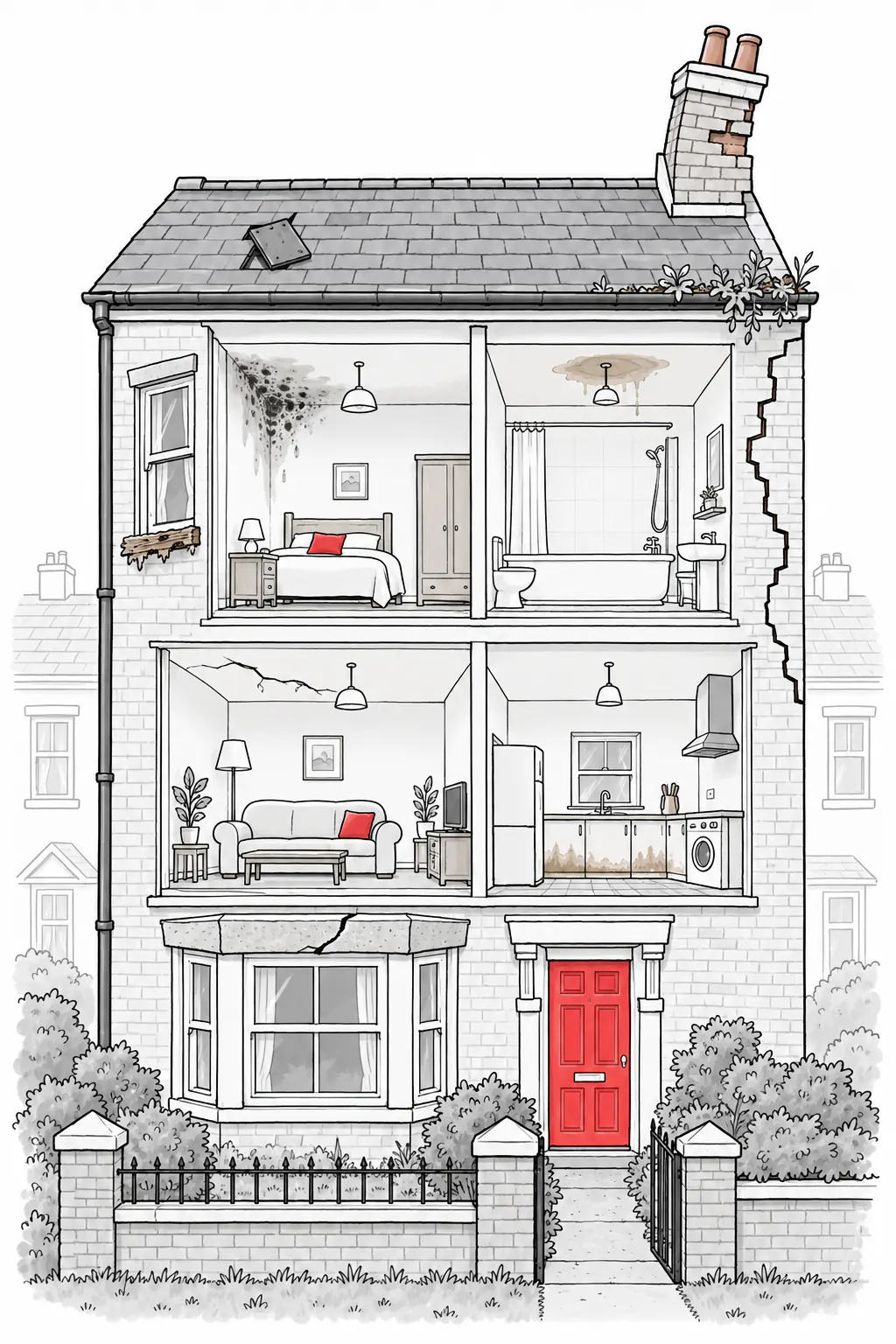
A cutaway drawing of an old terraced house with a cracked wall, a broken chimney, mould on a bedroom ceiling, a slipped slate and a rotten window sill

What’s covered

What a Level 3 covers, and what it can’t

The survey follows the RICS Home Survey Standard. This summary is drawn from RICS’s description of the Level 3 (February 2021).

The surveyor checks

  • The inside and outside of the main building and all permanent outbuildings, as much as can be physically reached.
  • The roof space where it is safe, lifting small corners of insulation to see its type and the ceiling below.
  • Boundary walls, fences and shared areas, walking the grounds and nearby public land.
  • The visible parts of the electrics, gas or oil, water, heating and drainage. For a flat, the drains, lifts, fire alarms and security systems in normal everyday use.
  • A desk-top study and enquiries about matters affecting the home, using a damp meter, binoculars, a torch and a ladder up to 3 metres.

The report gives you

  • A condition rating for each part: 3 serious or urgent, 2 repair needed but not urgent, 1 no repair needed now, and NI not inspected.
  • The most probable cause of each defect, the repair options, and what could happen if it is left.
  • The risks to the building, the grounds and people, and the documents to ask for before you sign contracts.
  • Advice on energy, including any obvious mismatch with the EPC and which improvements suit how the home is built.
  • Where practicable and agreed with the surveyor, an estimate of repair costs and likely timescale.

It can’t

  • Lift fitted carpets or floorboards, move heavy furniture or open up the building without the owner’s consent.
  • Test the services, so it can’t confirm the electrics, gas or plumbing are safe or efficient.
  • Inspect for asbestos, though the report flags materials that may contain it. On a flat, external wall systems aren’t inspected.
  • Give a market valuation or an insurance rebuild (reinstatement) figure. RICS treats these as extra services under separate terms.

Last reviewed against the RICS Home Survey Standard and RICS’s Level 3 description.

Condition ratings

  • 3: Serious or urgent. RICS uses 3 for parts with defects that are serious, or that need repairing, replacing or investigating urgently. Left alone, they could be a safety risk or cause serious long-term damage.
  • 2: Repair needed, not urgent. A 2 is a defect that needs repairing or replacing but is not serious or urgent. The part still needs normal maintenance.
  • 1: No repair needed now. A 1 means no repair is currently needed. It is not a guarantee: the part still needs looking after in the normal way.
  • NI: Could not be seen. NI means the surveyor could not inspect that part, for example because it was hidden, covered or unsafe to reach. The report says why.

How the report arrives

Digitally: we email you when it is ready, and the surveyor’s report is in your Homemove dashboard, usually 5 to 7 working days after the visit.

See a sample Level 3 report

Three sections from RICS’s Level 3 sample report, which uses a specimen home, not a real address. Download the sample report (70 pages, PDF 2.3 MB, RICS 2021), RICS’s current sample (RICS, August 2024), or read it section by section.

Level 1, 2 or 3

Level 2 or Level 3: which do you need?

A Level 3 goes further than a Level 2: a closer inspection, the likely cause of each defect and repair options. Here are the three levels RICS defines, side by side.

Older, altered or run-down homes

Level 3

Once the Building Survey

For
Older, larger, altered, unusual or run-down homes, or major works.
Surveyor
A thorough inspection; still doesn’t open up the building.
Ratings
Yes, with the likely cause of each defect
Repair advice
Repair options, and costs where practical and agreed
Valuation
Agree in advance
Typical price
Most paid £645 to £775
Report
Usually 5 to 7 working days after the visit

Most homes

Level 2

Once the HomeBuyer Report

For
Most homes: conventional, common materials, reasonable condition.
Surveyor
Inside and out, further into the roof space and drainage chambers than Level 1.
Ratings
Yes: 1, 2, 3 and NI
Repair advice
Yes, repairs and maintenance; no costs
Valuation
Only as a survey and valuation
Typical price
Most paid £445 to £499
Report
Usually 5 to 7 working days after the visit

Level 1

Once the Condition Report

For
A conventional home in good condition, when you only want ratings.
Surveyor
The lightest visual inspection.
Ratings
Yes: 1, 2, 3
Repair advice
No
Valuation
No
Typical price
£300 to £900 (HomeOwners Alliance, updated 22 October 2026)

Homemove doesn’t book Level 1. A Level 2 adds advice on repairs.

Inspection: two hours to a full day, depending on the home, at every level (RICS). Prices for Level 2 and 3 are what Homemove customers paid in the twelve months to 31 October 2026.

Read the full guide: which survey do I need?

Not sure? Two questions

Is the home over about 100 years old, or extended, altered or unusual?
Is it in poor condition, or do you plan major works?

For five questions and more kinds of home, use Which survey do I need?

From our panel’s reports

What surveyors rate 3 on older homes

The share of survey reports that rated each part 3, serious or urgent, where it was inspected. Leaving aside the services, which surveyors look at but don’t test.

Homes built before 1919

  1. Main walls35%
  2. Roof structure (loft)31%
  3. Roof coverings28%
  4. Chimney stacks25%
  5. Floors23%

Homes built 1919 to 1944

  1. Garage42%
  2. Roof coverings32%
  3. Roof structure (loft)32%
  4. Main walls28%
  5. Chimney stacks25%

From reports written by RICS-registered surveyors on our panel, June 2025 to October 2026. The age views use panel reports where the home’s age was recorded. Percentages only; no home, surveyor or firm can be picked out.

After the report

Red flags in a Level 3 report, and what to do

Read the 3s first. Get quotes and book any investigation before you exchange contracts, while you can still renegotiate.

  • Cracks or movement in the main walls rated 3

    The surveyor records cracks, distortion or movement, says what most probably caused it, and recommends a further investigation if they can’t be sure.

    Next: Book the specialist check the report asks for: it looks at that one problem, such as a crack, in depth, and is not another Level 3. Then get two written quotes for any repair before you exchange. Book a specialist structural check

  • Damp in walls or floors

    A Level 3 surveyor takes damp meter readings and names the area and the most probable cause.

    Next: Ask for a damp and timber survey by a CSTDB-qualified surveyor, as the Property Care Association advises. We don’t book these. Property Care Association advice

  • Roof coverings, chimneys or roof timbers rated 3

    Slipped or missing slates, a leaning stack, or rot or woodworm in the roof structure seen from the loft can be costly to put right.

    Next: Get a roofer’s or timber specialist’s written quote for each item before you exchange, and price it against the asking price. Estimate the repair cost

  • Alterations without consent

    Removed walls, loft conversions, extensions and replacement windows can need planning permission, building regulations sign-off or guarantees. RICS lists these under issues for your legal advisers.

    Next: Send that section to your solicitor so they ask the seller for the consents and sign-off before you exchange. Find a conveyancer

Then choose one of three

  1. Go ahead if you can live with what it found.
  2. Renegotiate or ask the seller to fix it, with two written quotes for each serious item. Price repairs and draft the letter
  3. Walk away before exchange. In England and Wales you aren’t committed until then.
A Homie surveyor in a hi-vis vest with both hands on their cheeks, looking shocked

How it works

From price to report in three steps

  1. 1

    Get your instant price

    Enter the address and see the fixed price for that home. It’s free, with no obligation.

  2. 2

    Book online

    Pay when you book. We match an independent RICS-regulated firm covering your postcode, and arrange access with the occupier. Tell the surveyor about any worries or planned works before the visit.

  3. 3

    Get your report

    The visit takes longer than a Level 2. Your report arrives in your dashboard, usually 5 to 7 working days after the visit.

You can cancel for a full refund until the surveyor visits. See how soon surveyors visit near you

Before you book

Worth it, valuation and Scotland

Is a Level 3 survey worth it?

For an older or altered home, usually. On homes built before 1919, surveyors on our panel rated the main walls 3 in 35% of reports where they were inspected, and the roof structure (loft) in 31%. A Level 3 also tells you the likely cause, so you can get the right quotes and renegotiate or walk away before you exchange.

Source: reports written by RICS-registered surveyors on our panel, June 2025 to October 2026, where the home’s age was recorded. See the older-homes chart

Is a mortgage valuation enough?

No. Your lender’s valuation is for the lender: it checks the home is worth the loan, not its condition, and you may never see it. A Level 3 is written for you.

Buying in Scotland?

The seller must give you a Home Report, which includes a survey and valuation by a chartered surveyor, so most buyers don’t book a Level 3 (mygov.scot, Scottish Government, updated 12 August 2020). Want your own survey as well? Add the postcode to the price tool and we’ll say whether a surveyor on our panel covers it.

Damp, rot or woodworm?

A Level 3 names the area and which specialist should look at it. The Property Care Association advises a damp and timber survey by a CSTDB-qualified surveyor (Property Care Association). We don’t book these.

Why Homemove

Why book your Level 3 survey through Homemove

Homemove has booked thousands of surveys for buyers across the UK.

  • RICS-regulated firms. An independent firm does every survey, working for you, not the agent or seller.
  • An instant price online, fixed before you pay, and a full refund if you cancel before the visit.
  • Your report in 5 to 7 working days after the visit, usually, in your dashboard.
  • Rated 4.6/5 from 291 reviews on Trustpilot.

As featured in

ITV News TV Appearance The Times Featured AI Tech Company The Guardian - Homemove Insert Feature
A Homie surveyor peering through a magnifying glass with a clipboard under one arm

FAQs

Level 3 survey questions

How much does a Level 3 survey cost?

Homemove customers paid a middle price of £685 in the twelve months to 31 October 2026, and most paid £645 to £775. The home’s value moves the price most, then its size and where it is. Enter the address and the price for that home shows before you book.

Is a structural survey the same as a Level 3?

Usually, yes. “Building survey”, “full structural survey” and “RICS Home Survey Level 3” are names for the same survey of the whole home. A structural engineer’s report is different: it looks at one problem, such as a crack or movement, in depth, and a Level 3 may recommend one.

What does a Level 3 survey include?

A thorough inspection of the inside and outside of the home and its permanent outbuildings, then a detailed report: a condition rating for each part, the likely cause of each defect, repair options and risks. Repair cost estimates are included only where practicable and agreed with the surveyor before the visit.

Does a Level 3 survey include a valuation?

No. RICS lists a market valuation and an insurance rebuild (reinstatement) figure as extra services under separate terms. Your Homemove quote is for the Level 3 survey; if you need a valuation too, tell us before you book.

Does the surveyor lift floorboards or go in the loft?

The surveyor goes into the roof space where it is safe, but doesn’t lift fitted carpets or floorboards, move heavy furniture or open up the building without the owner’s consent. Anything they can’t see is recorded as not inspected, with advice on whether it needs a further look.

How long does a Level 3 survey take?

The visit takes longer than a Level 2 on the same home; RICS says from two hours to a full day, depending on the home. The report usually follows 5 to 7 working days after the visit, once you’ve signed the surveyor’s terms.

Do I need a Level 3 survey in Scotland?

Usually not. In Scotland the seller must give you a Home Report, which includes a survey and valuation by a chartered surveyor. Want your own survey as well? Add the postcode to the price tool and we’ll say whether a surveyor on our panel covers it.

Can I book a survey after exchanging contracts?

You can, but by then you are committed to buy, so you can’t renegotiate or walk away over what it finds. Book as soon as your offer is accepted.

Sources

Last reviewed against the RICS Home Survey Standard.

Ready to book?

Get your fixed price in 20 seconds, with a full refund if you cancel before the visit.

Get your Level 3 price
4.6/5 from 291 reviews on Trustpilot

What happens after you pay

  1. We arrange access with the occupier and agree the visit date.
  2. The surveyor visits and inspects the home.
  3. Your report arrives in your dashboard, usually 5 to 7 working days after the visit.

Prefer to talk? Call 0333 050 2000, Monday to Friday, 9am to 5pm, or send us a message.

Which survey do I need? Level 2 vs Level 3 vs specialist