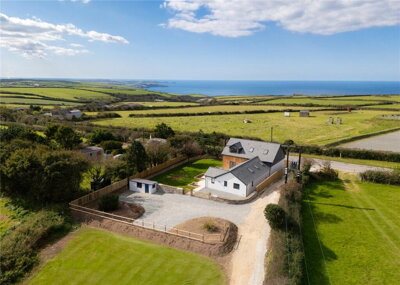
Browse 1 home new builds in St. Teath from local developer agents.
Teath from developers. The larger property sector typically features multiple bathrooms, substantial reception space, and private gardens or off-street parking. Four bedroom houses in St. Teath span detached, semi-detached, and occasionally terraced configurations, with styles ranging from period properties to modern executive homes.
The St. Teath property market reflects the broader trends affecting rural Cornwall, with house prices showing modest correction after several years of strong growth. As of February 2026, the overall average property price stands at £346,804, representing a 12-month change of -1.78%. Detached properties command the highest prices at an average of £408,600, offering generous space and often featuring substantial gardens that take full advantage of the surrounding countryside. These larger homes are particularly popular with families and buyers seeking a permanent residence rather than a holiday let, though they represent a significant investment compared to smaller property types.
Semi-detached homes in St. Teath average £280,000, providing an accessible entry point to village life for first-time buyers and those downsizing from larger properties. Terraced properties average £250,000 and are often the most affordable way to access the village's conservation area properties, many of which feature original stone walls, slate roofing, and period fireplaces that simply cannot be replicated in modern construction. Flats remain scarce in St. Teath, as the village's rural character and housing stock naturally lends itself to houses rather than apartments. First-time buyers should note that mortgage agreement in principle is essential before arranging viewings, as village properties can sell quickly when presented to the limited pool of local buyers.
New build developments within the St. Teath postcode area (PL30 4) remain limited, with no large-scale housing sites currently active in the immediate vicinity. Nearby schemes at Tregenna Parc in St Breward (developed by Gilbert and Goode, from £295,000) and The View in Delabole (also by Gilbert and Goode, from £250,000) offer new build alternatives, though these fall outside the St. Teath parish boundary. Buyers specifically seeking brand new construction may need to broaden their search to neighbouring villages, though purchasing an older property in St. Teath offers the advantage of character, solid construction, and the unique architectural style that defines this Conservation Area village.

Life in St. Teath unfolds at a gentle pace that many city dwellers find instantly appealing. The parish sits at the head of the Allen Valleys, with the River Allen flowing through the village and creating a verdant corridor of meadows and woodland that forms the backbone of local walks. The surrounding landscape is characterised by rolling hills and hedgerow-lined lanes typical of North Cornwall, offering residents daily encounters with wildlife and panoramic views across to Bodmin Moor on clear days. This is countryside that rewards exploration, whether on foot, by bicycle, or simply during a Sunday afternoon drive through the winding lanes that connect St. Teath to its neighbouring villages.
The village itself centres on the Grade I listed Church of St. Teath, a medieval landmark that anchors the Conservation Area and serves as a focal point for community life. The church dates from the 15th century and features an impressive tower that dominates the local skyline. Surrounding the church, a small cluster of cottages, farmhouses, and village buildings showcase the traditional Cornish architectural style: thick stone walls rendered in warm tones, natural slate roofs, and windows that speak to an era before modern building regulations standardised proportions. The village lacks major chain retailers, which actually contributes to its charm, though everyday necessities are available in nearby Delabole and Wadebridge.
The local economy draws from agriculture, tourism, and services, with many residents working in the surrounding area or commuting to larger towns. Proximity to popular coastal destinations like Port Isaac (famous as the filming location for Doc Martin) and the dramatic cliffs of Tintagel means tourism plays a significant role in the broader economy. Community spirit is strong in St. Teath, with regular events, a local pub providing a focal point for socialising, and the kind of neighbourly connections that are increasingly rare in urban settings. For buyers seeking a permanent home rather than a holiday property, the village offers an authentic Cornish experience that differs markedly from the tourist-focused coastal settlements.
Families considering a move to St. Teath will find educational provision centred on nearby villages and towns within reasonable commuting distance. St. Teath itself does not have a primary school within the parish boundaries, so primary-aged children typically attend schools in surrounding villages such as St. Breward (approximately 4 miles away), St. Kew, or Delabole. St. Breward Community Primary School serves the wider area and provides education for children from Reception through to Year 6, with the journey from St. Teath following scenic country lanes that take approximately 10-15 minutes by car. Parents are advised to check current catchment areas and admission policies with Cornwall Council, as school places can be competitive in popular rural areas.
Secondary education is provided at schools in Wadebridge and Bodmin, both accessible via school bus services that serve the St. Teath area. Wadebridge School serves as the main secondary option for North Cornwall families, offering a comprehensive curriculum and sixth form provision. The school has received mixed Ofsted ratings in recent years, and parents should review the latest inspection reports to make informed decisions about secondary placement. Bodmin College and other nearby secondary schools provide additional options depending on catchment boundaries and available places. For families prioritising academic excellence, several grammar schools operate in Cornwall, though admission is based on entrance testing rather than geographic proximity.
Further education opportunities are readily available at Cornwall College in Bodmin and Truro, offering A-levels, vocational courses, and higher education programmes. The college has campuses throughout Cornwall and maintains strong links with local employers, making it a practical option for school-leavers in the St. Teath area. Parents with younger children will also find a range of preschool and nursery options in nearby villages, though advance registration is recommended given limited places in rural settings. The absence of schools within the village itself is typical of small Cornish parishes and is offset by the strong sense of community that develops when families share school runs along the same country lanes.
Transport connections from St. Teath reflect its status as a rural village, with residents relying primarily on private vehicles for daily commuting and larger shopping trips. The village sits approximately 8 miles from Wadebridge, the nearest town offering full retail amenities, supermarkets, and banking services. The journey takes around 20 minutes via the B3266 and A39 roads, which pass through attractive countryside and connect St. Teath to the wider North Cornwall road network. Bodmin, the county town, lies approximately 15 miles away and requires around 30 minutes of driving, while Truro, Cornwall's largest city, sits roughly 35 miles distant with a typical journey time of 50-60 minutes under normal traffic conditions.
Public transport options are limited but do exist for those who prefer not to drive. Bus services operated by Cornwall Council connect St. Teath to Wadebridge, Bodmin, and surrounding villages, though frequencies are reduced compared to urban routes and timetable planning is essential for regular commuting. The nearest railway stations are at Bodmin Parkway (approximately 18 miles) and Par (approximately 25 miles), both offering connections to Plymouth, Exeter, and London Paddington via the mainline railway. London Paddington can typically be reached in around 4 hours from Bodmin Parkway, making St. Teath viable for occasional London commuting although the journey is lengthy for daily travel.
For buyers working remotely, St. Teath offers the broadband connectivity typical of rural Cornwall, though speeds may fall below those available in urban areas. Mobile signal can be variable depending on the network and specific location within the village, and buyers should test signal strength at any property they are seriously considering. The peaceful environment and lack of through traffic make St. Teath pleasant for those who work from home, while the stunning local scenery provides an inspiring backdrop for creative professionals. Cycling is popular on the quieter lanes, though the hilly terrain requires a reasonable level of fitness, and the North Cornwall coast path offers world-class walking for recreational excursions.
Before viewing any properties in St. Teath, obtain a mortgage agreement in principle from a lender. This confirms your budget and demonstrates to sellers that you are a serious buyer. Even in this rural village market, properties can move quickly when interest is genuine.
Spend time exploring St. Teath at different times of day and week. Visit the village centre, walk the local lanes, and speak with residents about their experience of living here. Check broadband speeds, mobile signal, and school catchments to ensure the area matches your priorities.
Work with estate agents listing properties in St. Teath to arrange viewings of suitable homes. Take a friend or family member for a second opinion, and note the property condition, construction materials, and any signs of damp or structural issues that might require further investigation.
Given the age of many properties in St. Teath, a RICS Level 2 Survey (HomeBuyer Report) is strongly recommended before proceeding with purchase. This inspection will identify defects common to traditional Cornish construction, including damp, roof condition, timber defects, and any signs of subsidence or movement.
Choose a conveyancing solicitor with experience handling rural property transactions in Cornwall. They will conduct searches including a mining search (Con29M) given Cornwall's mining heritage, investigate flooding risk from the River Allen, and ensure the property's title is clean before you commit.
Once all surveys, searches, and negotiations are complete, your solicitor will arrange for contracts to be signed and deposit paid. Completion typically follows within 2-4 weeks, at which point you will receive the keys to your new St. Teath home.
Properties in St. Teath present unique considerations that buyers should carefully evaluate before committing to purchase. The village's Conservation Area status means that many alterations, extensions, and exterior modifications require consent from Cornwall Council's planning department. Prospective buyers should review the property's planning history, check for any existing violations, and understand that future improvements may be constrained by conservation requirements. This is not necessarily a disadvantage, as the Conservation Area designation protects property values by preserving the architectural character that makes St. Teath attractive in the first place.
Building materials deserve particular attention in St. Teath properties. Traditional Cornish stone construction, while incredibly durable, requires different maintenance approaches compared to modern brick or block construction. Natural slate roofs, common throughout the village, may contain asbestos in properties dating from the mid-20th century, and replacement costs can be substantial. The local geology, characterised by Devonian slate and granite with areas of clay soil, means that some properties may be susceptible to shrink-swell movement if foundations are inadequate. A thorough RICS Level 2 Survey will identify any structural concerns and provide estimates for necessary repairs.
Flood risk in St. Teath is primarily associated with the River Allen and surface water drainage rather than coastal flooding, given the village's inland position. Buyers should review the Environment Agency's flood risk maps for the specific property location and consider whether flooding has affected the property historically. Properties in low-lying areas near the river valley may face occasional surface water issues during heavy rainfall. Insurance costs may be higher for properties with any flood history, and mortgage lenders will require flood risk to be assessed before proceeding.
Listed buildings require particularly careful consideration, as Grade I, Grade II*, and Grade II listed properties are subject to strict regulations governing alterations, repairs, and maintenance. A Level 3 Building Survey is generally more appropriate than a standard Level 2 for listed properties, as it provides more detailed analysis of construction, materials, and recommended conservation approaches. The additional cost of specialist surveys and Listed Building Consent applications should be factored into the overall budget when considering historic properties in St. Teath's conservation area.

As of February 2026, the average house price in St. Teath is £346,804. Detached properties average £408,600, semi-detached homes £280,000, and terraced properties £250,000. The market has shown a modest 12-month price decrease of approximately 1.78%, suggesting a stabilising market after previous years of growth driven by pandemic-era rural relocation trends. Approximately 20 properties sold in the past year, indicating moderate transaction volumes typical of a small rural village.
Properties in St. Teath fall under Cornwall Council's jurisdiction, with the village located within the PL30 4 postcode area. Bands range from A to H depending on property value, with the majority of traditional stone cottages and village centre properties likely falling in Bands A through D. Exact bands vary by individual property, and buyers should check the specific band with Cornwall Council or on the property listing before budgeting for ongoing costs. Council tax payments in Cornwall typically run from April each year, and village properties in conservation areas often fall into lower bands due to historical rateable values.
St. Teath does not have a primary school within the parish, so children typically attend schools in nearby villages such as St. Breward (approximately 4 miles away) or St. Kew. St. Breward Community Primary School serves the wider area and has a small, rural setting typical of North Cornwall village schools. Secondary education is provided at Wadebridge School and other schools in Bodmin, accessible via school bus services. Parents should verify current catchment areas with Cornwall Council, as school admission policies can affect placement decisions in popular rural areas where demand sometimes exceeds places available.
Public transport options in St. Teath are limited but functional for occasional travel. Bus services connect the village to Wadebridge and Bodmin, though frequencies are reduced compared to urban routes and timetable planning is essential for regular commuting. The nearest railway stations are at Bodmin Parkway (approximately 18 miles) and Par (approximately 25 miles), offering connections to Plymouth, Exeter, and London Paddington. Daily commuting to major employment centres is practical only for those working remotely or with flexible arrangements, as journey times to Truro and Exeter are substantial at around 50-60 minutes each way under normal traffic conditions.
St. Teath offers moderate investment potential for those seeking a lifestyle purchase or a long-term hold in a desirable North Cornwall village. The property market is relatively small with approximately 20 transactions annually, which limits both opportunity and liquidity. Rural village properties tend to appreciate steadily over long periods rather than experiencing rapid capital growth. Holiday let potential exists given proximity to the North Cornwall coast and destinations like Port Isaac and Tintagel, though Conservation Area restrictions and planning consent requirements may limit rental opportunities compared to purpose-built holiday accommodation. Properties commanding premium prices in St. Teath typically feature original character, generous gardens, or views across the Allen Valleys.
Stamp Duty Land Tax (SDLT) rates for standard purchases are 0% on the first £250,000, 5% on £250,001 to £925,000, 10% on £925,001 to £1.5 million, and 12% above £1.5 million. First-time buyers benefit from relief on the first £425,000 (0% up to £425,000, then 5% to £625,000), though this relief does not apply above £625,000. Given St. Teath's average price of £346,804, most buyers would pay no SDLT as first-time purchasers, or a minimal amount as non-first-time buyers. The calculation for a standard buyer would be 5% on the amount above £250,000, which equals £4,840.20 on a £346,804 property.
The primary risks associated with older properties in St. Teath include damp (rising, penetrating, and condensation), deterioration of traditional slate roofing, timber defects such as rot and woodworm, and potential structural movement related to clay soils. Many properties predate modern building standards, meaning electrical wiring, plumbing, and insulation may require upgrading. Properties built between the 1950s and 1990s may contain asbestos in roofing felt, artex coatings, or insulation materials. A comprehensive RICS Level 2 Survey will identify these issues before purchase, allowing you to renegotiate the price or factor remediation costs into your budget.
From £400
A detailed inspection of the property condition, essential for traditional stone construction
From £80
Energy performance certificate required for all sales
From £499
Legal services for your property purchase
From 3.89%
Expert mortgage guidance for St. Teath buyers
Properties New Builds In London

Properties New Builds In Plymouth

Properties New Builds In Liverpool

Properties New Builds In Glasgow

Properties New Builds In Sheffield

Properties New Builds In Edinburgh

Properties New Builds In Coventry

Properties New Builds In Bradford

Properties New Builds In Manchester

Properties New Builds In Birmingham

Properties New Builds In Bristol

Properties New Builds In Oxford

Properties New Builds In Leicester

Properties New Builds In Newcastle

Properties New Builds In Leeds

Properties New Builds In Southampton

Properties New Builds In Cardiff

Properties New Builds In Nottingham

Properties New Builds In Norwich

Properties New Builds In Brighton

Properties New Builds In Derby

Properties New Builds In Portsmouth

Properties New Builds In Northampton

Properties New Builds In Milton Keynes

Properties New Builds In Bournemouth

Properties New Builds In Bolton

Properties New Builds In Swansea

Properties New Builds In Swindon

Properties New Builds In Peterborough

Properties New Builds In Wolverhampton

Enter your details to see if this property is within your budget.
Loans, cards, car finance
Estimated property budget
Borrowing + deposit
You could borrow between
Typical borrowing
Monthly repayment
Est. at 4.5%
Loan-to-value
This is an estimate only. Your actual budget may vary depending on interest rates, credit history, and personal circumstances. For an accurate affordability assessment, speak to one of our free mortgage advisors.
This calculator provides estimates for illustrative purposes only and does not constitute financial advice. Your home may be repossessed if you do not keep up repayments on your mortgage. Estimates based on 4.5% interest rate, repayment mortgage. Actual rates depend on your circumstances.
Homemove is a trading name of HM Haus Group Ltd (Company No. 13873779, registered in England & Wales). Homemove Mortgages Ltd (Company No. 15947693) is an Appointed Representative of TMG Direct Limited, trading as TMG Mortgage Network, which is authorised and regulated by the Financial Conduct Authority (FRN 786245). Homemove Mortgages Ltd is entered on the FCA Register as an Appointed Representative (FRN 1022429). You can check registrations at NewRegister or by calling 0800 111 6768.

We use cookies to show you personalised content and improve your experience of our website. Find out more in our Privacy policy and Cookie policy.