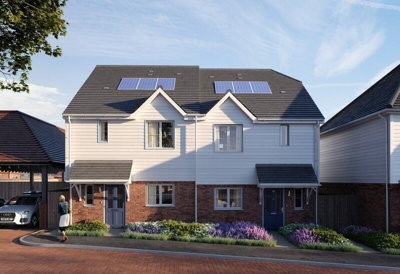
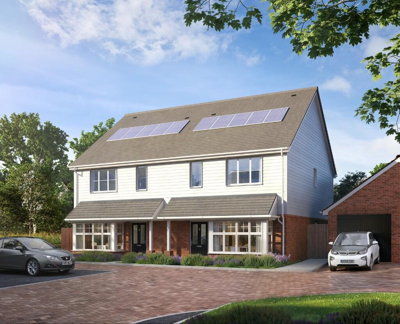
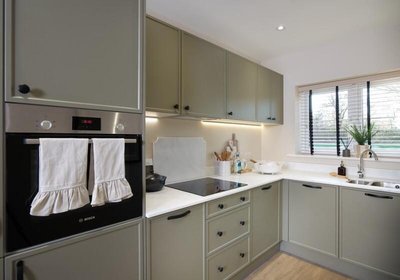
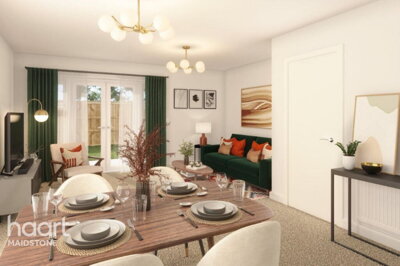
Browse 4 homes new builds in Paddock Wood from local developer agents.
Three bedroom properties represent a significant portion of the Paddock Wood housing market, offering space for families with multiple reception rooms and gardens in many cases. Browse detached, semi-detached, and terraced options ranging across new residential developments.
The Paddock Wood property market offers exceptional variety across all property types, catering to different budgets and lifestyles. Detached homes command the highest prices, averaging £657,117, reflecting the generous space and privacy these properties afford. Semi-detached houses, which form a significant portion of the local housing stock at 34.7%, average £422,963, making them popular among families seeking more affordable alternatives to detached living. Terraced properties average £347,214 and represent 20.1% of homes, offering excellent value for first-time buyers looking to enter this desirable market.
The market has experienced modest cooling over the past year, with overall prices decreasing by 1.15%. This correction has created opportunities for buyers, particularly in the terraced and flat segments, which saw slightly larger declines of 1.40% and 1.63% respectively. Two significant new build developments are currently active in Paddock Wood. Mascalls Grange by Barratt Homes offers 2, 3, 4, and 5-bedroom homes priced from £399,995 to £749,995, located on Mascalls Court Road. Meanwhile, The Hoplands by Bellway provides 2, 3, and 4-bedroom properties ranging from £379,995 to £649,995 on Maidstone Road. Both developments present attractive options for those seeking modern construction with energy-efficient specifications and developer warranties.
According to Census 2021 data, the Paddock Wood and Horsmonden ward contains 3,828 households with a population of 9,515 residents. The housing stock breakdown shows that detached properties comprise 30.2% of homes, semi-detached houses account for 34.7%, terraced properties represent 20.1%, and flats and maisonettes make up the remaining 14.9%. This mix of property types ensures that buyers with varying requirements can find suitable options within the local market.
Paddock Wood's character has been shaped by its rich agricultural heritage, particularly its historical connections to fruit growing and the hop industry that once dominated the Kent countryside. Today, the town maintains a proud identity while embracing modern living. The settlement has a population of approximately 9,515 residents across 3,828 households, creating a vibrant community where neighbours know one another and local events bring people together throughout the year. The town centre features a pleasing mix of independent retailers and high street favourites, with a monthly farmers market attracting visitors from surrounding villages.
The surrounding Kent landscape offers exceptional natural beauty, with rolling farmland, ancient woodlands, and scenic footpaths waiting to be explored. The Weald of Kent is renowned for its picturesque villages, vineyards, and historic castles, providing endless weekend adventures for residents. Locally, you will find several parks and green spaces perfect for family gatherings and outdoor recreation. The town also hosts an annual carnival and Christmas lights switch-on, fostering the strong community spirit that makes Paddock Wood such a desirable place to call home.
The local economy benefits from Paddock Wood's position as an important distribution hub, with a large industrial estate and major railway freight terminal providing employment in logistics and warehousing. Many residents also commute to nearby Tunbridge Wells and Maidstone for work, taking advantage of the excellent transport links while enjoying the lifestyle benefits of village living. This economic diversity helps maintain stable property values and ensures consistent demand for housing in the area.

Education provision in Paddock Wood serves families well, with several primary schools within the town and surrounding villages. These schools benefit from dedicated teaching staff and strong community involvement, achieving good outcomes for students across Key Stage 1 and Key Stage 2. Parents moving to Paddock Wood frequently cite the quality of local education as a major factor in their decision, with smaller class sizes and individual attention that larger towns cannot always provide. The surrounding Tunbridge Wells borough is known for its selective grammar school system, and prepared students from Paddock Wood regularly compete for places at these prestigious schools.
Secondary education options include schools in nearby towns that are easily accessible by school bus services. For families considering private education, several well-regarded independent schools are located within reasonable driving distance. Further education opportunities are abundant, with colleges in Tunbridge Wells and Maidstone offering A-levels and vocational qualifications. The strong educational infrastructure makes Paddock Wood particularly attractive to families planning their children's academic journey from primary school through to university entrance.
The proportion of families with children in Paddock Wood is notably high compared to some neighbouring areas, reflecting the family-friendly nature of the community. This demographic profile supports local schools and contributes to the active social scene centred around family activities and events. When searching for property in Paddock Wood, parents should verify current catchment areas and admission policies directly with schools, as these can change and may influence which properties prove most suitable for your family's educational needs.
Paddock Wood railway station provides regular services to London Bridge, with journey times of approximately 50-55 minutes to the capital. This makes the town particularly attractive to commuters who require easy access to central London while enjoying the benefits of countryside living. The station also offers direct connections to Hastings on the south coast, providing additional travel options for leisure and business. Parking facilities at the station accommodate commuters, though these spaces can fill quickly during peak hours, so arriving early is advisable.
Road connectivity is excellent, with the A228 passing through the town and providing links to the M20 motorway at Maidstone and the A21 at Tunbridge Wells. This positions Paddock Wood within easy reach of the Channel ports and Eurotunnel terminal for those considering continental travel or European property purchases. Local bus services connect Paddock Wood with surrounding villages and nearby towns, serving residents who prefer not to drive. Cycling infrastructure continues to improve, with National Cycle Route 18 passing through the area and connecting cyclists to the wider Kent cycle network.
The combination of rail and road access makes Paddock Wood particularly appealing to buyers who work in London or other major centres but wish to enjoy the lifestyle benefits of Kent countryside living. Journey times to Gatwick Airport are approximately 45 minutes by car, opening up international travel options for residents. The accessibility of Paddock Wood continues to attract buyers who might previously have focused on towns closer to London, as the value proposition of larger properties and community atmosphere proves increasingly attractive compared to higher-priced urban alternatives.
Properties in Paddock Wood and the surrounding Kent area reflect the region's distinctive building heritage, with traditional brick construction in red or yellow hues commonly found on older properties. This colouring comes from the local clay geology, which has historically influenced building material choices throughout the Weald. Tile roofs are standard on period properties, while some older buildings feature ragstone, a local Kentish stone, or traditional timber framing. Rendered finishes appear on certain properties, adding visual variety to the streetscape. Understanding the construction materials used in your potential property helps you anticipate maintenance requirements and plan for future upkeep costs.
The age distribution of housing stock in Paddock Wood shows significant post-war expansion, with many properties constructed between 1945 and 1980. Pre-1919 buildings are concentrated in older farmhouses and cottages in surrounding rural areas, while inter-war housing estates from 1919-1945 add to the variety of property ages. Post-1980 construction includes numerous modern developments from the late 20th and early 21st centuries. Pre-1945 properties typically feature solid wall brick construction, timber framing, and clay roof tiles, with foundations that may be shallower than modern standards. Post-1945 buildings generally use cavity wall brick construction, concrete tiled roofs, and more standardised foundation depths.
New build properties from developments such as Mascalls Grange and The Hoplands typically feature timber frame or modern masonry construction with a mix of brick, render, and sometimes cladding. These modern specifications often include improved insulation, double glazing, and energy-efficient heating systems that meet current building regulations. The warranty coverage provided by NHBC or similar schemes on new properties offers additional protection that older properties cannot provide. When evaluating different properties in Paddock Wood, the construction era and building materials should inform your assessment of potential maintenance costs and renovation requirements.
Given the Weald Clay geology underlying Paddock Wood, our inspectors frequently identify subsidence and heave as concerns during property surveys. The shrink-swell properties of this high clay content soil mean the ground can expand significantly when wet and contract during dry periods. Properties with shallow foundations, particularly older buildings, are most vulnerable to this ground movement. Large trees planted close to buildings exacerbate the risk as their root systems extract moisture from the clay, causing the soil to shrink. Our surveyors pay particular attention to crack patterns, door and window operation, and any signs of previous structural movement when inspecting properties in the Paddock Wood area.
Damp represents another common defect our inspectors find in Paddock Wood properties, particularly in buildings constructed before modern building standards were introduced. Rising damp, penetrating damp, and condensation issues appear across the housing stock, often exacerbated by poor ventilation or deferred maintenance. Timber defects including wet rot, dry rot, and woodworm can affect older timber elements, especially where damp conditions have developed. Our team recommends that buyers factor potential remediation costs into their budget when purchasing older properties, as damp and timber treatments can prove costly if problems have been allowed to develop over many years.
Roof defects consistently feature in survey reports for Paddock Wood properties over 50 years old. Worn roof coverings, whether tiles, slates, or concrete tiles, often show signs of deterioration including cracked or slipped units, defective flashings, and damaged guttering. These issues can lead to water ingress and subsequent damage to timbers and ceilings if not addressed promptly. Outdated electrical systems and plumbing appear frequently in pre-1980 properties, where wiring and pipework may not meet current safety standards. Properties with original windows, doors, or heating systems may require comprehensive upgrading to achieve comfortable modern living standards and meet current energy efficiency requirements.
Start by exploring our listings to understand what Paddock Wood properties offer at your budget. Consider proximity to schools, the railway station, and local amenities. The town has diverse neighbourhoods, from older terraced streets near the centre to modern developments on the outskirts including Mascalls Grange on Mascalls Court Road and The Hoplands on Maidstone Road. We recommend spending time in the area at different times of day before narrowing your search.
Once you have identified suitable properties, contact the listing estate agents to arrange viewings. We recommend viewing multiple properties to compare value and condition. Consider visiting at different times of day to assess noise levels, traffic, and the neighbourhood atmosphere. Pay particular attention to the property's proximity to the railway line, as trains can generate significant noise for properties near the track or freight terminal.
Before making an offer, obtain a mortgage agreement in principle from a lender. This strengthens your position with sellers and demonstrates your seriousness as a buyer. Our mortgage partners can help you compare rates and find the most suitable product for your circumstances. Having your finances arranged before bidding gives you a significant advantage in Paddock Wood's competitive property market.
When you find your ideal property, submit an offer through the estate agent. Be prepared to negotiate on price and terms. In Paddock Wood's market, having your finances already arranged puts you in a strong position against other buyers. Our team can provide guidance on local market conditions and comparable sales to help you formulate a realistic offer.
Before completing your purchase, arrange a RICS Level 2 Survey to assess the property's condition. Given Paddock Wood's Weald Clay geology, pay particular attention to any signs of subsidence, damp, or structural movement that the surveyor identifies. Our team works with qualified RICS surveyors who understand local construction methods and common defect patterns in the Paddock Wood area.
Choose a conveyancing solicitor to handle the legal aspects of your purchase. They will conduct searches, review contracts, and coordinate with the seller's solicitor until completion. Our conveyancing partners offer competitive fixed fees for Paddock Wood property transactions and understand the local search requirements including drainage and flood risk assessments relevant to the area.
Prospective buyers should be aware that Paddock Wood sits on Weald Clay, a geology known for its shrink-swell properties that can cause ground movement. This makes subsidence risk assessment particularly important, especially for older properties with potentially shallow foundations or those situated near mature trees. A thorough survey can identify any existing movement or risk factors that might affect the property's long-term structural integrity. Properties on Mascalls Court Road and near the railway freight terminal may face additional considerations regarding noise and heavy vehicle traffic.
Flood risk is another factor to consider, as the River Teise and its tributaries run through Paddock Wood, posing fluvial flood risk during periods of heavy rainfall. Properties in low-lying areas or those near watercourses should be carefully evaluated, and buyers should review the Environment Agency's detailed flood risk maps before committing to a purchase. Surface water flooding can also occur during exceptional rainfall events, so drainage conditions around the property merit attention during viewings and surveys. Your solicitor will typically conduct local searches that include drainage and water authority checks for Paddock Wood properties.
Many properties in Paddock Wood were constructed after the post-war period, meaning a significant proportion of the housing stock is now over 50 years old. These properties may exhibit common issues including outdated electrical systems, aging plumbing, and original windows that would benefit from upgrading. If you are considering a period property, budget for potential renovation costs alongside the purchase price. Newer developments like Mascalls Grange and The Hoplands offer modern construction with fewer maintenance concerns and the added reassurance of NHBC or similar warranties. Our team can help you understand which properties in Paddock Wood are likely to require additional investment beyond the purchase price.
The average house price in Paddock Wood is currently £437,133, based on the most recent data. Detached properties average £657,117, semi-detached homes cost around £422,963, terraced properties average £347,214, and flats are typically priced at approximately £225,278. The market has seen modest price decreases of around 1.15% over the past 12 months, creating opportunities for buyers in this desirable Kent location. With 109 property sales recorded in the past year, transaction volumes indicate an active market with good choices for prospective buyers.
Properties in Paddock Wood fall under Tunbridge Wells Borough Council. Council tax bands range from A through to H, with the majority of residential properties falling in bands B through E. The exact band depends on the property's assessed value, which was determined at the 1991 valuation and has not been updated since. You can verify the specific band for any property through the Valuation Office Agency website or by checking the listing details provided by the estate agent.
Paddock Wood offers good primary school options serving the local community, with schools in the town and surrounding villages achieving positive Ofsted outcomes. For secondary education, students often attend schools in nearby Tunbridge Wells, which includes access to the Kent grammar school system with its selective admission process. Several independent schools are also within reasonable driving distance, including options in both Kent and East Sussex. Families should verify current catchment areas and admission policies directly with the schools, as these can influence which properties prove most suitable for your children's education.
Paddock Wood railway station provides regular services to London Bridge with journey times of approximately 50-55 minutes, making it an excellent location for commuters working in the capital. Direct trains to Hastings on the south coast are also available, providing convenient access to coastal towns for leisure. Local bus services connect the town with surrounding villages and towns including Tunbridge Wells and Maidstone. The A228 road provides good access to the M20 at Maidstone and the A21 at Tunbridge Wells, positioning Paddock Wood favourably for those who travel by car.
Paddock Wood offers solid fundamentals for property investment. The town's economy is supported by its railway freight terminal, distribution hub, and proximity to major employment centres including London, Maidstone, and Tunbridge Wells. Rental demand is driven by commuters and families seeking the area's combination of village charm and transport links. With new developments adding housing stock and good schools attracting families, Paddock Wood maintains its appeal as a long-term investment location in the Kent property market. The ongoing demand from buyers and tenants suggests resilient property values going forward.
Stamp duty rates (SDLT) in England currently apply at 0% on the first £250,000 of residential property purchases, 5% on the portion from £250,001 to £925,000, and 10% on amounts between £925,001 and £1.5 million. For properties above £1.5 million, the rate is 12%. First-time buyers purchasing properties up to £625,000 can claim relief, paying 0% on the first £425,000 and 5% on the remainder. Given Paddock Wood's average price of £437,133, a typical buyer would pay approximately £9,357 in stamp duty, though first-time buyers could pay considerably less under the relief scheme.
Flood risk varies across Paddock Wood depending on location and proximity to watercourses. The River Teise flows through the area and its tributaries can pose fluvial flood risk during periods of heavy rainfall, particularly affecting low-lying areas and properties near watercourses. Surface water flooding can also occur during exceptional rainfall events when drainage systems become overwhelmed. We strongly recommend that buyers review the Environment Agency's detailed flood risk maps for the specific property location and factor any flood risk into their purchasing decision. Properties in higher-risk areas may require additional insurance considerations.
We recommend a RICS Level 2 Survey for most properties in Paddock Wood, particularly given the local Weald Clay geology and the significant proportion of housing stock over 50 years old. Survey costs typically range from £400 to £700 depending on property size and complexity, with larger detached properties at the higher end of this range. A Level 2 Survey provides a detailed assessment of the property's condition, identifying defects including subsidence risk, damp issues, roof defects, and outdated electrics that commonly affect Paddock Wood properties. For listed buildings or those with complex historical construction, a more comprehensive RICS Level 3 Building Survey may prove more appropriate.
Understanding the full cost of purchasing property in Paddock Wood requires careful budgeting beyond the advertised price. The stamp duty land tax (SDLT) represents a significant consideration for most buyers. At current rates, a buyer purchasing a property at the Paddock Wood average price of £437,133 would pay approximately £9,357 in stamp duty, assuming they do not qualify for first-time buyer relief. Those purchasing with the first-time buyer exemption could pay considerably less, with relief available on properties up to £625,000, reducing the SDLT to around £605 for eligible buyers.
Additional purchase costs include solicitor fees for conveyancing, typically ranging from £500 to £1,500 depending on the complexity of the transaction. Local searches conducted by your solicitor, including drainage and water searches, water authority checks, and local authority queries, generally cost between £200 and £400. A RICS Level 2 Survey is strongly recommended for Paddock Wood properties, particularly given the local Weald Clay geology, with costs typically ranging from £400 to £700 depending on property size and complexity. For a typical 3-bedroom semi-detached house in Paddock Wood, survey fees are likely to fall in the £450-600 range. Mortgage arrangement fees, valuation fees, and broker costs should also be factored into your budget, along with moving expenses and any immediate renovation works you plan to undertake after completion.
From 3.84%
Compare rates from leading lenders to find the best mortgage for your Paddock Wood property purchase
From £499
Expert solicitors handling your Paddock Wood property transaction
From £400
Comprehensive condition survey ideal for Paddock Wood's varied housing stock
From £80
Energy performance certificate required for all property sales
Properties New Builds In London

Properties New Builds In Plymouth

Properties New Builds In Liverpool

Properties New Builds In Glasgow

Properties New Builds In Sheffield

Properties New Builds In Edinburgh

Properties New Builds In Coventry

Properties New Builds In Bradford

Properties New Builds In Manchester

Properties New Builds In Birmingham

Properties New Builds In Bristol

Properties New Builds In Oxford

Properties New Builds In Leicester

Properties New Builds In Newcastle

Properties New Builds In Leeds

Properties New Builds In Southampton

Properties New Builds In Cardiff

Properties New Builds In Nottingham

Properties New Builds In Norwich

Properties New Builds In Brighton

Properties New Builds In Derby

Properties New Builds In Portsmouth

Properties New Builds In Northampton

Properties New Builds In Milton Keynes

Properties New Builds In Bournemouth

Properties New Builds In Bolton

Properties New Builds In Swansea

Properties New Builds In Swindon

Properties New Builds In Peterborough

Properties New Builds In Wolverhampton

Enter your details to see if this property is within your budget.
Loans, cards, car finance
Estimated property budget
Borrowing + deposit
You could borrow between
Typical borrowing
Monthly repayment
Est. at 4.5%
Loan-to-value
This is an estimate only. Your actual budget may vary depending on interest rates, credit history, and personal circumstances. For an accurate affordability assessment, speak to one of our free mortgage advisors.
This calculator provides estimates for illustrative purposes only and does not constitute financial advice. Your home may be repossessed if you do not keep up repayments on your mortgage. Estimates based on 4.5% interest rate, repayment mortgage. Actual rates depend on your circumstances.
Homemove is a trading name of HM Haus Group Ltd (Company No. 13873779, registered in England & Wales). Homemove Mortgages Ltd (Company No. 15947693) is an Appointed Representative of TMG Direct Limited, trading as TMG Mortgage Network, which is authorised and regulated by the Financial Conduct Authority (FRN 786245). Homemove Mortgages Ltd is entered on the FCA Register as an Appointed Representative (FRN 1022429). You can check registrations at NewRegister or by calling 0800 111 6768.

We use cookies to show you personalised content and improve your experience of our website. Find out more in our Privacy policy and Cookie policy.