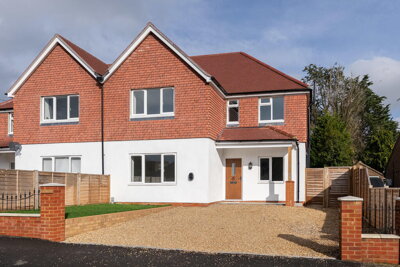
Browse 1 home new builds in Ockley, Mole Valley from local developer agents.
£1.15M
14
1
164
Source: home.co.uk
Source: home.co.uk
Detached
7 listings
Avg £1.56M
Semi-Detached
3 listings
Avg £591,667
Bungalow
1 listings
Avg £1.10M
End of Terrace
1 listings
Avg £525,000
Equestrian Facility
1 listings
Avg £1.15M
House
1 listings
Avg £1.25M
Source: home.co.uk
Source: home.co.uk
The High Halden property market reflects the character of this rural village, with detached properties commanding the highest prices at an average of £666,250. These generously proportioned homes, many set within substantial plots, attract families and buyers seeking space for home offices or multi-generational living. The village's housing stock shows remarkable variety, from historic farmhouses within the conservation area to contemporary detached houses on recent developments, providing options across different price points and lifestyle requirements.
Semi-detached properties in High Halden average £391,667, representing strong value for buyers seeking family-sized accommodation in a village setting. These homes often feature the traditional Kentish architecture with generous gardens and convenient access to village amenities. Terraced properties average £325,000, offering an accessible entry point to village life for first-time buyers or those downsizing from larger homes. Recent market activity shows 12 properties have changed hands in the past twelve months, with prices showing a modest seasonal adjustment of 0.4% across all property types, suggesting a stable market rather than significant volatility.
New build options in High Halden include The Oaks and The Paddocks developments by Pentland Homes on Bethersden Road (TN26 3LY), offering two, three, four, and five-bedroom homes. These developments provide modern energy-efficient housing with the advantage of NHBC guarantees, appealing to buyers who prioritise low maintenance and contemporary construction standards. The preference for houses over flats in the village is striking, with 60.5% of the housing stock being detached properties and only 4% comprising apartments, underscoring the village's family-oriented and rural character.
Property types break down further across the village, with semi-detached homes at 24.3% of stock and terraced properties at 11.2%. This distribution reflects High Halden's evolution from a traditional farming settlement through post-war expansion to recent new build development, creating a housing landscape that offers everything from characterful period cottages to modern family homes on well-designed estates.

High Halden is a village that captures the essence of Kentish rural life, with a population of 1,847 residents across 709 households according to the 2021 Census. The village sits within a landscape shaped by the Weald, characterised by rolling farmland, orchards, and woodland that define the Kent countryside. The community maintains a strong sense of identity despite its modest size, with local events, parish activities, and the familiar faces of village life creating an atmosphere that larger towns simply cannot replicate.
The village centre revolves around its historic church, primary school, and local amenities that serve day-to-day needs. The conservation area encompasses the historic core, protecting the architectural heritage that includes St Mary's Church and numerous listed buildings ranging from medieval farmhouses to Victorian cottages. The predominant construction materials reflect Kent's building traditions, with red brick and weatherboard featuring prominently on period properties, while newer developments incorporate a mix of brick and render that respects local aesthetics without compromising on modern standards.
The local economy centres on agriculture and small businesses, with many residents choosing the village for its quality of life rather than proximity to employment. The appeal of good local schools, scenic countryside, and a genuine community atmosphere makes High Halden particularly attractive to families and those seeking to escape the pressures of urban living. The village benefits from a post office, local shop, and pub, while the nearby market towns of Tenterden and Headcorn provide additional services and social venues. For cultural attractions, residents enjoy access to the Kent countryside with its footpaths and bridleways, historic houses, and vineyards that have become a feature of the region.
The Kentish Weald offers exceptional countryside access, with hundreds of miles of public footpaths and bridleways winding through farmland, woodland, and past historic landmarks. Local vineyards including those in the wider Ashford area have developed into popular visitor destinations, reflecting the region's growing reputation for quality English wine. The proximity to the High Weald Area of Outstanding Natural Beauty means residents benefit from protected landscapes and strong planning controls that maintain the rural character of the surrounding area.
Education provision in High Halden centres on the village primary school, which serves families with children from reception through to Year 6. The presence of a good primary school within walking distance is a significant factor for families considering village life, eliminating the need for school transport and allowing children to build friendships within the community from an early age. Parents moving to High Halden often cite the village school as a key driver in their decision, alongside the safety and independence that village living provides for older children.
For secondary education, pupils typically travel to schools in nearby towns, with grammar schools in Ashford and Tenterden attracting academically-minded students from across the surrounding villages. The Kent grammar school system provides a pathway to selective education, with schools such as The North School in Ashford and Homewood School and Sixth Form Centre in Tenterden serving the local area. Parents should research catchment areas and admissions criteria carefully, as school places can be competitive for properties outside the immediate vicinity of oversubscribed schools.
Sixth form and further education options expand significantly with access to colleges in Ashford and Canterbury, providing A-level and vocational courses for students continuing their education beyond GCSE. The proximity to the University of Kent in Canterbury offers higher education opportunities within reasonable commuting distance, making High Halden a practical base for families with university-age children who wish to remain connected to the family home while pursuing degree programmes.
Beyond formal education, the village benefits from various youth activities and clubs that operate through the school and parish council. These range from sports teams to music groups and scouting organisations, providing enrichment opportunities that contribute to the strong family community that characterises village life in High Halden.

High Halden enjoys strategic positioning that balances rural tranquility with practical transport connections. The village lies within easy reach of the M20 motorway, providing direct access to the Channel ports of Dover and Folkestone, as well as connections to London via the M25 orbital route. Ashford International station, approximately eight miles away, offers high-speed rail services to London St Pancras in under one hour, making the village viable for commuters who need regular access to the capital without living within the city itself.
Local bus services connect High Halden with surrounding villages and market towns, providing essential transport for those without private vehicles. Routes to Tenterden and Ashford enable access to larger shopping centres, healthcare facilities, and additional rail services. For air travel, Gatwick Airport is accessible via the motorway network in approximately one hour, while Heathrow requires slightly longer journey times. The absence of a direct railway station within the village means that commuting by rail typically requires a car journey to the nearest station, a factor buyers should consider when evaluating the practicalities of daily travel.
Cyclists and walkers benefit from the Kent countryside's extensive public rights of way network, with footpaths and bridleways connecting the village to neighbouring communities and countryside attractions. The relatively flat terrain in parts makes cycling feasible for shorter journeys, though the rural road network requires caution given the absence of dedicated cycling lanes on busier routes. Parking provision within the village is generally adequate for residents, though visitors during peak periods may find spaces limited near the village centre and local amenities.
The nearest railway stations at Headcorn and Pluckley provide regular services to London Bridge, offering alternative options for commuters who find Ashford International too far for regular travel. Headcorn station is approximately 6 miles from High Halden village centre, while Pluckley is slightly further north, both providing rural station parking that can be more convenient than navigating to Ashford during peak periods.
Begin by exploring High Halden's property market on Homemove, reviewing current listings, average prices, and the types of property available. Understanding the local housing stock and how prices compare across detached, semi-detached, and terraced properties will help you set realistic expectations and identify good value in this village market.
Before arranging viewings, obtain a mortgage agreement in principle from a lender or broker. This financial checkpoint demonstrates to estate agents and sellers that you are a serious buyer with funding in place, strengthening your position when making offers on properties in this village market where detached family homes at £666,250 average command significant interest.
Contact estate agents to arrange viewings of properties matching your requirements. In High Halden, viewings allow you to assess the condition of traditional properties, check for signs of damp or subsidence given the Weald Clay geology, and appreciate the village's character and amenities from a resident's perspective.
Once your offer is accepted, instruct a RICS Level 2 Survey to assess the property's condition comprehensively. Given that many High Halden properties are over 50 years old and built on shrink-swell clay soil, a professional survey is essential for identifying structural issues, damp problems, or timber defects before you commit to purchase. Survey costs in the TN26 3 postcode area typically range from £450 to £700 for a three-bedroom semi-detached and £600 to £900 or more for larger detached properties.
Appoint a solicitor experienced in rural property transactions to handle the legal aspects of your purchase. They will conduct searches including local authority checks through Ashford Borough Council, environmental searches for flood risk, and coordinate with your mortgage lender to ensure funds are transferred correctly on completion day.
Your solicitor will arrange the exchange of contracts once all searches are satisfactory and your mortgage offer is confirmed. Completion typically follows within days or weeks, at which point you will receive the keys to your new High Halden home and can begin settling into village life.
Properties in High Halden require careful inspection given the area's specific geological and environmental characteristics. The underlying Weald Clay presents a particular challenge for buyers, as this shrink-swell clay can cause subsidence in properties with shallow foundations during periods of drought or excessive rainfall. When viewing properties, look carefully for diagonal cracking around door frames, windows that stick when opening, and uneven floors that may indicate ground movement. A RICS Level 2 Survey is strongly recommended for any property, but becomes essential for older homes with potentially inadequate foundations on this challenging soil type.
Older properties in High Halden were typically constructed with solid brick walls in Flemish or English bond, timber frames with infill panels, and pitched roofs covered with clay tiles or slate. Foundations were frequently shallow, making these traditional construction methods particularly vulnerable to movement on shrinkable clay soils. Post-war properties from 1945 to 1980 introduced cavity wall construction with brick outer leaf and block inner leaf, along with concrete tiled roofs, offering improved thermal performance but still requiring careful inspection of the original construction quality.
Flood risk warrants careful consideration despite High Halden's inland position. Surface water flooding can occur along roads and in low-lying areas during heavy rainfall, while small watercourses and drainage ditches may pose occasional flooding risks to properties nearby. Review the property's flood history, check the elevation relative to surrounding land, and consider the drainage characteristics of the plot before purchasing. Properties within or near the conservation area may face additional planning restrictions that affect alterations, extensions, or even permitted development rights, so buyers should verify these constraints with Ashford Borough Council.
The age distribution of High Halden's housing stock means that many properties will require updating of electrical systems, heating systems, and insulation to meet modern standards. Look for signs of outdated consumer units, absence of modern wiring, and single-glazed windows that will incur ongoing costs to improve. Properties built before 2000 may contain asbestos in Artex coatings, floor tiles, or pipe insulation, requiring specialist removal if disturbed during renovation works. Factor these potential costs into your budget when assessing the true cost of purchasing a period property in the village.
The average house price in High Halden stands at £572,167 as of early 2026, according to aggregated Land Registry data. Detached properties average £666,250, semi-detached homes cost around £391,667, and terraced properties average £325,000. The market has shown remarkable stability with a 12-month price change of just 0.4% across all property types, indicating steady demand rather than volatile price swings that characterise some urban markets.
Properties in High Halden fall under Ashford Borough Council's jurisdiction for council tax purposes. Bands range across the full spectrum from A through to H, depending on the property's assessed value. Period cottages and smaller terraced homes typically occupy bands A to C, while larger detached properties and modern family homes commonly fall into bands D through F. Prospective buyers should verify the specific band with the listing agent or during conveyancing searches, as council tax forms part of the ongoing cost of ownership alongside mortgage payments, buildings insurance, and maintenance reserves.
High Halden has a village primary school serving children from reception through Year 6, which families with young children can typically walk to from anywhere in the village. For secondary education, grammar schools in Ashford and Tenterden attract academically-minded pupils from the surrounding villages, alongside comprehensive options including The North School and Homewood School and Sixth Form Centre. The proximity to good primary education within the village itself is frequently cited by families as a major advantage of living in High Halden.
High Halden has limited public transport options, with local bus services providing connections to Tenterden and Ashford but not offering the frequency or coverage of urban routes. The nearest railway stations are in Headcorn and Pluckley, offering services to London Bridge and other destinations, though Ashford International with its high-speed service to St Pancras is approximately eight miles away. Most residents rely on private vehicles for daily commuting, making car ownership essential for those working beyond the village or needing regular access to services in larger towns.
High Halden offers several characteristics that make it attractive to property investors, including a stable market with modest price appreciation potential and strong rental demand from commuters and families seeking village life. The predominantly detached housing stock with generous gardens holds broad appeal, while the limited supply of new properties helps maintain values. However, investors should note that the 4% flat stock means rental options are heavily concentrated in houses, and the village's rural character means tenant demand may be more niche than in commuter belt towns with more extensive transport options. Rental yields in rural villages typically range between 4% and 6% gross, depending on property type and condition.
Stamp duty land tax applies to all property purchases above £250,000 at standard rates, with buyers paying nothing on the first £250,000, 5% on the portion from £250,001 to £925,000, 10% up to £1.5 million, and 12% on any amount above that. First-time buyers benefit from relief on purchases up to £625,000, paying 0% on the first £425,000 and 5% on the amount between £425,001 and £625,000, with no relief available above that threshold. For a typical £572,167 detached property, a first-time buyer would pay approximately £7,358 in stamp duty after relief.
High Halden has a designated conservation area covering the historic village centre around St Mary's Church, and numerous listed buildings throughout the parish. Properties within the conservation area face restrictions on alterations, extensions, and even exterior maintenance that require approval from Ashford Borough Council. Listed buildings carry Grade II or higher designations that protect their architectural features, requiring listed building consent for most works that would affect the building's character. Buyers planning renovations should consult the planning portal and consider engaging a heritage consultant for older properties.
Understanding the full cost of purchasing property in High Halden extends beyond the headline sale price to encompass stamp duty, legal fees, surveys, and moving costs. For a detached property at the current average price of £666,250, a buyer who is not a first-time purchaser would incur approximately £20,813 in stamp duty land tax under the standard 2024-25 thresholds. First-time buyers benefit significantly from the relief available on properties up to £625,000, though at the average price, the relief would be partially tapered, making the effective rate lower than for repeat buyers.
Survey costs represent an essential investment given the specific challenges of the local housing stock. RICS Level 2 Surveys in High Halden typically cost between £450 and £700 for a three-bedroom semi-detached property, rising to £600 to £900 or more for larger four-bedroom detached homes. These surveys provide professional assessment of construction quality, identifying defects ranging from subsidence signs on Weald Clay to damp penetration and timber deterioration common in period properties. The cost is modest relative to the property value and potential repair bills that might otherwise go undetected.
Conveyancing fees for High Halden purchases generally range from £499 to £1,500 depending on the complexity of the transaction and whether the property is freehold or leasehold. Local search fees through Ashford Borough Council, environmental searches, and bankruptcy checks typically add £250 to £400 to the legal costs. Moving costs vary according to distance and volume of belongings, but for a local move within Kent, budget between £500 and £2,000 for professional removal services. Building insurance must be in place from the point of exchange, typically costing £200 to £500 annually depending on property value and coverage requirements.
Beyond the immediate purchase costs, new homeowners should budget for immediate expenditure such as utility connections, furnishings, and any essential repairs identified during survey. Properties with outdated heating systems may require boiler replacement within the first few years of ownership, while properties lacking modern insulation will generate higher ongoing energy costs. Setting aside a contingency fund equivalent to 10-15% of the purchase price for unexpected works and improvements is prudent for anyone buying a period property in the village.
Properties New Builds In London

Properties New Builds In Plymouth

Properties New Builds In Liverpool

Properties New Builds In Glasgow

Properties New Builds In Sheffield

Properties New Builds In Edinburgh

Properties New Builds In Coventry

Properties New Builds In Bradford

Properties New Builds In Manchester

Properties New Builds In Birmingham

Properties New Builds In Bristol

Properties New Builds In Oxford

Properties New Builds In Leicester

Properties New Builds In Newcastle

Properties New Builds In Leeds

Properties New Builds In Southampton

Properties New Builds In Cardiff

Properties New Builds In Nottingham

Properties New Builds In Norwich

Properties New Builds In Brighton

Properties New Builds In Derby

Properties New Builds In Portsmouth

Properties New Builds In Northampton

Properties New Builds In Milton Keynes

Properties New Builds In Bournemouth

Properties New Builds In Bolton

Properties New Builds In Swansea

Properties New Builds In Swindon

Properties New Builds In Peterborough

Properties New Builds In Wolverhampton

Enter your details to see if this property is within your budget.
Loans, cards, car finance
Estimated property budget
Borrowing + deposit
You could borrow between
Typical borrowing
Monthly repayment
Est. at 4.5%
Loan-to-value
This is an estimate only. Your actual budget may vary depending on interest rates, credit history, and personal circumstances. For an accurate affordability assessment, speak to one of our free mortgage advisors.
This calculator provides estimates for illustrative purposes only and does not constitute financial advice. Your home may be repossessed if you do not keep up repayments on your mortgage. Estimates based on 4.5% interest rate, repayment mortgage. Actual rates depend on your circumstances.
Homemove is a trading name of HM Haus Group Ltd (Company No. 13873779, registered in England & Wales). Homemove Mortgages Ltd (Company No. 15947693) is an Appointed Representative of TMG Direct Limited, trading as TMG Mortgage Network, which is authorised and regulated by the Financial Conduct Authority (FRN 786245). Homemove Mortgages Ltd is entered on the FCA Register as an Appointed Representative (FRN 1022429). You can check registrations at NewRegister or by calling 0800 111 6768.

We use cookies to show you personalised content and improve your experience of our website. Find out more in our Privacy policy and Cookie policy.