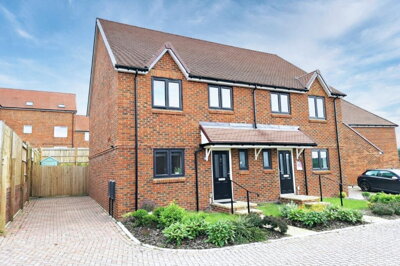
Browse 2 homes new builds in East Grinstead from local developer agents.
Three bedroom properties represent a significant portion of the East Grinstead housing market, offering space for families with multiple reception rooms and gardens in many cases. Browse detached, semi-detached, and terraced options ranging across new residential developments.
£395,000
Average Price
£477,500
Median Price (2025)
£486,667
Detached Average
£393,333
Semi-Detached Average
6
Properties Sold (2025)
-38.8%
Price Change (12 months)
The property market in High Roothing reflects its status as a village with predominantly older, character-rich housing stock. Detached properties dominate the sales mix, accounting for 50% of all transactions, with an average price of £486,667 and a median of £495,000 based on 2025 sales data. These substantial family homes represent the upper tier of the local market, appealing to buyers seeking space, privacy, and the opportunity to own property in a designated conservation area. The village's position within Uttlesford district, consistently recognised for its quality of life indicators, adds further appeal to these larger detached homes.
Semi-detached properties in High Roothing sold at a median price of £390,000 over the past year, with the average sitting around £393,333. These homes provide an accessible entry point to village life, offering families adequate space without the premium associated with detached plots. Terraced properties, though rarer in this market, have achieved median prices of £365,000, demonstrating consistent demand for compact period homes with historical character. Flats remain particularly scarce in High Roothing, with limited transaction data suggesting values around £275,000 for the rare units that do come to market. The overall market has experienced significant correction over the past 12 to 24 months, with prices falling approximately 38.8% year-on-year and sitting 30% below the 2018 peak of £632,896, creating potential opportunities for well-positioned buyers.
Properties along The Street form the historic backbone of the village, with many timber-framed cottages and former farmworkers' dwellings lining this main thoroughfare. The sales data for High Roothing shows that period properties in good condition command premium prices, while those requiring renovation often attract investors and buyers willing to undertake restoration projects. Given the limited number of properties that typically come to market in any given year, serious buyers should monitor listings closely and be prepared to move quickly when suitable homes for sale in High Roothing become available.

Understanding the construction methods prevalent in High Roothing helps prospective buyers appreciate what they are purchasing and anticipate maintenance requirements. The village's historic properties predominantly feature timber-framed construction, with oak frames visible in the characteristic jetted upper floors and carved dragon posts that distinguish Essex timber-framed buildings from those in other regions. These traditional construction techniques, developed over centuries, create homes of remarkable character but require understanding of how older structures behave compared to modern buildings.
Thatched roofing remains a defining feature of High Roothing's architectural heritage, with at least half of the listed buildings in the village retaining their original thatch coverings. Modern thatch typically uses water reed or long straw, applied by specialist thatchers who understand the traditional craft. The pitch and detail of thatched roofs in High Roothing varies according to the period of construction, with earlier properties often featuring steeper pitches and more elaborate ridge details. While thatch provides excellent insulation and a distinctive appearance, it requires re-thatching every 30 to 40 years, representing a significant maintenance commitment that prospective buyers should factor into their budget calculations.
Later additions to the village housing stock include brick-built properties from the Georgian and Victorian periods, typically featuring lime mortar pointing and sash windows rather than the casement windows common in earlier timber-framed buildings. Essex red brick features prominently in boundary walls and outbuildings throughout the village, creating the characteristic warm tones that complement the black and white timber-framed houses. These later buildings often have different maintenance profiles, with potential issues including render failure, rising damp, and solid floor condensation that differ from the timber-related concerns of earlier properties.
Properties in High Roothing present characteristic defect patterns that reflect their age and construction methods. Timber-framed buildings are susceptible to woodworm infestation, particularly the common furniture beetle (Anobium punctatum) which targets softwood and old hardwood timbers throughout Essex villages. Our inspectors frequently identify active woodworm damage in structural timbers, floorboards, and roof rafters during surveys of period properties in the High Roothing area. Treatment costs vary depending on the extent of infestation, but early identification through a thorough property survey can prevent minor issues from developing into significant structural concerns.
Thatched roofs require specialist assessment due to their unique construction and the potential for hidden deterioration. Our surveyors check for signs of water penetration, bird damage, and the presence of vermin that can destabilise thatch over time. The condition of ridge work, hip ends, and the interface between thatch and any chimney stacks represents critical areas where deterioration often begins. Given the specialist nature of thatching repairs and the cost implications, a detailed assessment of roof condition represents essential due diligence before purchasing any thatched property in High Roothing.
Essex clay soils underlying the High Roothing area create potential for subsidence and ground movement that affects properties throughout the region. Our inspectors examine properties for signs of structural movement, including diagonal cracking, sticking doors and windows, and rippling plasterwork that may indicate ongoing ground movement. While High Roothing itself is not in a designated high-risk flood zone, the surrounding farmland and local watercourses mean that drainage conditions should be assessed as part of any thorough property evaluation. Traditional properties with shallow foundations may show minor movement over time, which our surveyors distinguish from more serious structural defects requiring immediate attention.
High Roothing is a village that rewards those who appreciate architectural heritage and rural tranquility. The population of 581 residents (2021 Census) creates an intimate community atmosphere where neighbours know one another and local events foster a genuine sense of belonging. The village centre features a collection of properties that showcase centuries of English building tradition, with timber-framed houses and thatched roofs forming the backbone of the historic built environment. The Hundred Parishes Society has documented conservation area appraisals available through Uttlesford District Council, recognising the special character that makes High Roothing distinctive among Essex villages.
Daily life in High Roothing is shaped by its location within the Dunmow postcode area (CM6) and its proximity to larger settlements. Residents enjoy access to country walks through the surrounding farmland, with public rights of way connecting the village to neighbouring communities including Great Canfield, Bobbingworth, and the wider network of villages that make up the Hundred Parishes region. The network of footpaths and bridleways radiating from The Street provides excellent opportunities for walking and cycling, with routes passing through farmland, woodland, and past historic hedgerows that support diverse wildlife populations throughout the year.
The village's proximity to the market town of Dunmow provides practical amenities including shops, pubs, and services, while the city of Chelmsford lies within reasonable reach for those requiring broader retail, healthcare, or entertainment facilities. Dunmow town centre offers a selection of independent retailers, cafes, and the weekly market that has operated from the town square for generations. The combination of village charm, historical character, and accessibility positions High Roothing as an attractive location for buyers seeking to balance countryside living with practical connectivity to the employment centres and amenities of greater Essex.

High Roothing residents rely primarily on the nearby market town of Dunmow for everyday shopping and services, with the journey taking approximately 10 minutes by car along the B184. Dunmow town centre features a range of independent shops including a traditional butcher, baker, and green grocers alongside familiar high street names and several charity shops. The town's Co-operative Food store provides convenient grocery shopping, while the twice-weekly market offers fresh local produce and creates a focal point for community interaction that echoes the rhythms of village life.
Healthcare provision in the area includes GP surgeries in Dunmow, with the nearest hospitals located in Chelmsford and Braintree for more specialist treatment. Dental practices in Dunmow and surrounding towns serve local residents, though appointment availability may require travelling further afield for NHS dental care. The village location means that residents should consider travel times to medical facilities when evaluating properties in High Roothing, particularly for families with young children or those with ongoing health requirements.
Dining options near High Roothing include several pubs and restaurants within easy driving distance, with establishments in Dunmow and the surrounding villages offering everything from traditional pub fare to more refined dining experiences. The location within the heart of the Essex countryside provides excellent access to farm shops and producers, with seasonal fruit and vegetables, free-range eggs, and locally reared meat available from farms in the surrounding area. These local food sources contribute to the quality of life that makes village living attractive to buyers seeking a slower pace of life without complete isolation from modern conveniences.
Families considering a move to High Roothing will find educational provision within the surrounding Uttlesford district, known for its network of primary and secondary schools. The village falls within the catchment areas for several local primary schools that serve the surrounding villages, providing education for children from early years through to Key Stage 2. Primary schools in the surrounding area include in Dunmow and the surrounding villages, with schools in Great Easton and Takeley also serving parts of the Uttlesford district. Parents are advised to verify specific catchment areas with Essex County Council, as admission policies can influence school allocation for any given property address.
Secondary education options in the wider area include schools in Dunmow and Stansted Mountfitchet, with Uttlesford district offering a mix of academy and local authority maintained schools that regularly feature in national performance rankings. The Helena Romanes School in Great Dunmow provides secondary education with sixth form provision, while studies in Bishop's Stortford and Stansted Mountfitchet offer alternative options for families seeking different educational approaches. Transport arrangements for secondary pupils typically involve school bus services, though the timing and routes should be checked against specific property locations before committing to a purchase.
For families requiring specialist educational provision or independent schooling, the broader Essex area offers additional options. Several independent schools within reasonable commuting distance serve families seeking alternative educational approaches, including schools in Chelmsford and Saffron Walden that serve the wider region. Sixth form provision is available at secondary schools with sixth forms in the surrounding towns, while Further Education colleges in Chelmsford and Colchester provide vocational and academic pathways for older students. Parents are advised to research specific school catchments and admissions criteria, as these can vary and may influence property values in particular streets or neighbourhoods throughout the High Roothing area.
Transport connectivity from High Roothing centres on road networks that link the village to surrounding towns and cities. The village sits approximately 9 miles northwest of Chelmsford, with the journey by car taking around 25 to 30 minutes depending on traffic conditions and route choice. The A130 and A120 provide primary arterial routes connecting High Roothing to the wider Essex road network, offering access to Stansted Airport, the M11 motorway, and the towns of Braintree and Colchester. For residents commuting to London, Stansted Airport offers domestic and international flights alongside rail connections.
The B184 provides direct access from High Roothing to Dunmow town centre, connecting with the A120 for routes toward Braintree and beyond. Journey times to Stansted Airport average around 25 to 30 minutes, making the village reasonably accessible for business travellers requiring air connections. The M11 junction 8 at Stansted offers direct access to Cambridge to the north and London to the south, with the journey to the capital typically taking around an hour depending on traffic conditions. The village's rural character means that practical consideration of transport options is an important aspect of property search for those who need to commute or access services regularly.
Rail services accessible from nearby stations provide connections to London's Liverpool Street and other regional destinations. Bishop's Stortford and Stansted Mountfitchet stations on the West Anglia Main Line offer regular services to the capital, with journey times to London typically ranging from 40 to 55 minutes depending on the specific service and departure point. Stansted Mountfitchet station is the closer option, approximately 12 miles from High Roothing, while Bishop's Stortford offers additional services including Greater Anglia routes to Norwich and Cambridge. Bus services connect High Roothing with surrounding villages and the market town of Dunmow, providing essential connectivity for those without private vehicle access, though service frequencies are limited compared to urban routes.
Start by understanding High Roothing's property market, including recent sale prices for comparable properties, local school catchments, and transport options. Our platform provides current listings alongside historical price data that can inform your understanding of local values. Pay particular attention to the condition of older properties and factor in potential survey costs for timber-framed and thatched buildings.
Once you have identified properties of interest, arrange viewings through the estate agents listing properties in High Roothing. Consider visiting at different times of day and checking the surrounding neighbourhood before making an offer. For period properties, request information about previous renovation work, thatch age, and any planning permissions obtained in recent years.
Before making an offer on a property, approach lenders to obtain an agreement in principle. This strengthens your position as a buyer and demonstrates to sellers that you have secured financing subject to survey and legal processes. Specialist lenders may be required for properties with non-standard construction such as timber frames or thatched roofs.
Given High Roothing's prevalence of older, timber-framed, and thatched properties, a RICS Level 2 Survey is essential. This homebuyer report will identify any structural issues, defects in older construction, and potential concerns with thatched roofs or timber elements that require specialist attention. For listed buildings or properties with significant renovation requirements, consider a more comprehensive RICS Level 3 Building Survey.
Once your offer is accepted, instruct a conveyancing solicitor to handle the legal aspects of your purchase. They will conduct searches, review contracts, and manage the transfer of ownership through to completion. Given the conservation area status of High Roothing, your solicitor should specifically check for any planning conditions or restrictions that may affect your intended use of the property.
After satisfactory survey results and completed legal processes, you will exchange contracts and pay your deposit. Completion follows shortly after, when the remaining funds are transferred and you receive the keys to your new High Roothing home. Allow time for utility transfers and any immediate maintenance requirements identified during your survey before moving day.
Purchasing property in High Roothing requires particular attention to the characteristics of the village's older housing stock. With many properties dating from the 14th century onwards and featuring timber-framed construction, prospective buyers should arrange thorough surveys that can identify issues common to historic buildings. Thatched roofs, present on at least half of listed buildings, require specialist maintenance and periodic re-thatching, representing a significant ongoing cost that should be factored into purchasing decisions. A RICS Level 2 Survey provides detailed assessment of these elements, identifying any signs of timber decay, woodworm, or roof condition issues that may not be apparent during standard viewings.
The conservation area status of High Roothing brings additional considerations for buyers. Properties within designated conservation areas may be subject to planning restrictions on alterations, extensions, or modifications that affect the external appearance of buildings. English Heritage and Uttlesford District Council guidance applies to listed buildings, which require consent for certain works. Prospective buyers should verify any planning history, check for any outstanding enforcement notices, and understand the implications of conservation area designation before committing to a purchase. Service charges and maintenance arrangements for any shared elements should also be clarified, particularly for converted properties or those with communal grounds.
Electrical and plumbing systems in older High Roothing properties frequently require updating to meet modern standards and regulations. Rewiring projects are common in period cottages, particularly those that have not been updated since the 1960s or earlier, when rubber and fabric-covered cables were standard installation. Similarly, plumbing from the Victorian or Edwardian period may use lead or iron pipes that require replacement. Our surveyors check the condition of these services and report on their compliance with current electrical and building regulations, helping you understand the scope of any upgrades required after purchase.
The average price paid for properties in High Roothing is currently around £395,000 as of early 2026, with the median sale price for 2025 sitting at £477,500 based on 6 recorded sales. Detached properties average £486,667 while semi-detached homes have sold at approximately £393,333. The market has experienced notable price correction over recent years, sitting approximately 30% below the 2018 peak of £632,896, which may present buying opportunities for those entering the village property market.
Properties in High Roothing fall within Uttlesford District Council's jurisdiction. Council tax bands are assigned based on property valuation, and bands for village properties typically range from Band A through to Band H for substantial period homes. Prospective buyers should verify the specific band for any property through the Valuation Office Agency or the local council's online records, as bands can affect ongoing running costs and should be factored into budget calculations alongside mortgage payments and utility costs. The band can be checked using the property address on the government council tax valuation site.
High Roothing is served by primary schools in the surrounding villages and catchment areas, with several primary schools within reasonable distance serving families with younger children. Secondary education options in the wider Uttlesford district include schools in Dunmow and Stansted Mountfitchet. Families are advised to research specific school catchments, admission arrangements, and performance data through Ofsted reports and government league tables to identify the most suitable options for their children's education. The Helena Romanes School in Great Dunmow is one of the larger secondary options serving the area, while independent schools in Chelmsford and Saffron Walden provide alternatives for families seeking private education.
High Roothing is a rural village where private transport is the primary means of getting around, though bus services connect the village to Dunmow and surrounding areas for local journeys. Rail connections are available at stations in Bishop's Stortford and Stansted Mountfitchet, providing access to London's Liverpool Street station with journey times typically between 40 and 55 minutes. Stansted Airport is accessible for domestic and international travel, located approximately 15 to 20 miles from the village. Daily commuters should consider the practical requirements of accessing these transport hubs from High Roothing, including parking arrangements at stations and the timing of bus connections.
High Roothing offers potential for property investment given its conservation area status, limited housing stock, and proximity to major employment centres and transport links. The village's concentration of character properties, including timber-framed and thatched homes, creates appeal for buyers seeking period homes in rural settings. While recent price corrections have brought values lower than previous peaks, the fundamental appeal of Uttlesford district and the village's architectural heritage suggests long-term stability. Any investment decision should consider the rural location, limited local amenities within the village itself, and the potential for maintenance costs on older properties.
Stamp Duty Land Tax rates for standard purchases (2024-25) apply at 0% on the first £250,000, 5% on £250,001 to £925,000, 10% on £925,001 to £1.5 million, and 12% on amounts exceeding £1.5 million. First-time buyers benefit from relief on the first £425,000 (0% rate) with 5% applying between £425,001 and £625,000. Given that High Roothing's average property price of around £395,000 to £477,500 falls within the lower brackets for most buyers, stamp duty costs should be manageable, though the calculation depends on purchase price, buyer status, and whether you own other properties.
New build activity within High Roothing itself is extremely limited, with most "new build" properties in the CM6 postcode area being individual homes rather than large developments. The village's conservation area status and heritage constraints make substantial new development unlikely. Some opportunities may exist for barn conversions or the renovation of existing outbuildings, which can offer character with modern specifications. Prospective buyers interested in new build should broaden their search to include the wider Dunmow area and neighbouring villages where larger developments may be available.
Thatched properties in High Roothing require specialist survey attention, with particular focus on roof condition, ridge work, and the interface between thatch and any chimney stacks or dormers. Our surveyors check for signs of water penetration, vermin damage, and the condition of any lightning protection systems that may be fitted to older thatched buildings. The type of thatch used (water reed, long straw, or combed wheat reed) affects longevity and maintenance requirements, and this should be documented during survey. Electrical installations in thatched properties require careful checking due to the increased fire risk associated with older thatch construction.
Understanding the full costs of purchasing property in High Roothing requires careful consideration of stamp duty alongside other expenses. For a property priced at the current median of £477,500, a standard buyer would pay no stamp duty on the first £250,000 and 5% on the amount between £250,001 and £477,500, totalling approximately £11,375. First-time buyers purchasing properties up to £425,000 would pay no stamp duty at all, making High Roothing's village properties potentially attractive for those entering the property market for the first time.
Beyond stamp duty, buyers should budget for survey costs, with a RICS Level 2 Survey typically starting from £350 depending on property value and size. Given High Roothing's older housing stock, this survey is particularly important for identifying defects in timber-framed construction and thatched roofs. Conveyancing fees for legal work typically start from £499 for standard purchases, though complexity involving listed buildings or conservation area properties may increase costs. Additional expenses include search fees, Land Registry fees, and removal costs. Getting a mortgage agreement in principle before viewing properties is advisable, as this clarifies your budget and demonstrates serious intent to sellers in what remains a competitive village market.
Ongoing costs for properties in High Roothing include council tax (Uttlesford District Council), building and contents insurance (typically higher for thatched properties), and maintenance reserves for period features. Energy efficiency improvements may be constrained by listed building or conservation area considerations, potentially affecting utility costs compared to newer properties. Prospective buyers should factor these ongoing costs into their budget calculations alongside mortgage payments when determining what they can afford to spend on a property in High Roothing.
From 4.5%
Specialist mortgage advice for village properties
From £499
Legal services for your property purchase
From £350
Essential survey for period properties
From £60
Energy performance certificate
Properties New Builds In London

Properties New Builds In Plymouth

Properties New Builds In Liverpool

Properties New Builds In Glasgow

Properties New Builds In Sheffield

Properties New Builds In Edinburgh

Properties New Builds In Coventry

Properties New Builds In Bradford

Properties New Builds In Manchester

Properties New Builds In Birmingham

Properties New Builds In Bristol

Properties New Builds In Oxford

Properties New Builds In Leicester

Properties New Builds In Newcastle

Properties New Builds In Leeds

Properties New Builds In Southampton

Properties New Builds In Cardiff

Properties New Builds In Nottingham

Properties New Builds In Norwich

Properties New Builds In Brighton

Properties New Builds In Derby

Properties New Builds In Portsmouth

Properties New Builds In Northampton

Properties New Builds In Milton Keynes

Properties New Builds In Bournemouth

Properties New Builds In Bolton

Properties New Builds In Swansea

Properties New Builds In Swindon

Properties New Builds In Peterborough

Properties New Builds In Wolverhampton

Enter your details to see if this property is within your budget.
Loans, cards, car finance
Estimated property budget
Borrowing + deposit
You could borrow between
Typical borrowing
Monthly repayment
Est. at 4.5%
Loan-to-value
This is an estimate only. Your actual budget may vary depending on interest rates, credit history, and personal circumstances. For an accurate affordability assessment, speak to one of our free mortgage advisors.
This calculator provides estimates for illustrative purposes only and does not constitute financial advice. Your home may be repossessed if you do not keep up repayments on your mortgage. Estimates based on 4.5% interest rate, repayment mortgage. Actual rates depend on your circumstances.
Homemove is a trading name of HM Haus Group Ltd (Company No. 13873779, registered in England & Wales). Homemove Mortgages Ltd (Company No. 15947693) is an Appointed Representative of TMG Direct Limited, trading as TMG Mortgage Network, which is authorised and regulated by the Financial Conduct Authority (FRN 786245). Homemove Mortgages Ltd is entered on the FCA Register as an Appointed Representative (FRN 1022429). You can check registrations at NewRegister or by calling 0800 111 6768.

We use cookies to show you personalised content and improve your experience of our website. Find out more in our Privacy policy and Cookie policy.