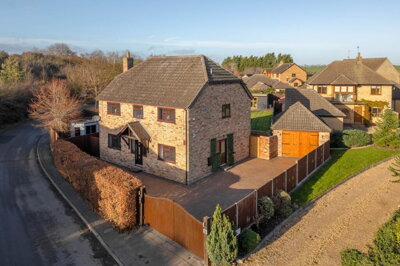
Browse 1 home for sale in Wood Walton from local estate agents.
The larger property sector typically features multiple bathrooms, substantial reception space, and private gardens or off-street parking. Four bedroom houses in Wood Walton span detached, semi-detached, and occasionally terraced configurations, with styles ranging from period properties to modern executive homes.
The Wood Walton property market reflects the dynamics of a small rural Cambridgeshire village, with the average house price standing at £305,000 over the past year. This figure represents a notable shift in market conditions, with prices down 42% compared to the previous year and 27% below the 2022 peak of £415,800. For context, properties in the broader PE28 postcode area around Beville, Woodwalton, averaged £395,000 over the same period. These variations highlight how micro-location within Cambridgeshire can significantly impact property values, with the village centre commanding different prices than properties on the outskirts or adjacent to the fenland areas.
Rightmove records indicate approximately 34 property sales in Woodwalton over the past twelve months, though this figure may not capture the complete market activity within the parish boundary. The housing stock in Wood Walton includes a mix of traditional period properties, with historic buildings constructed from stone and thatch reflecting the village's medieval origins. Detached properties with generous gardens are particularly well-represented, appealing to families and buyers seeking the space that village living in Cambridgeshire can offer. New build activity within the village itself remains limited, with nearby developments such as those at Alconbury Weald offering alternatives for buyers specifically seeking modern construction.
Our inspectors frequently assess properties across Cambridgeshire fenland villages, and we observe that Wood Walton properties often feature construction characteristics typical of the region. Properties near the village centre tend to be older, constructed with traditional methods using locally sourced materials where available. The combination of Oxford Clay bedrock and the proximity to Woodwalton Fen creates specific building conditions that have shaped construction throughout the village's history. Buyers should understand that these geological factors influence both property condition and the potential for certain defects to occur.
Prospective buyers should note that the Wood Walton market operates differently from urban property searches in cities like Cambridge or Peterborough. The smaller pool of available properties means that opportunities can arise less frequently, and buyers may need to act promptly when suitable homes become available. The village's agricultural economy and fenland setting create a distinctive market character that differs from the commuter-belt properties closer to Cambridge, offering genuine rural living at more accessible price points than comparable villages nearer to the city.

Life in Wood Walton centres on the rhythm of the fenland landscape, where agriculture remains the cornerstone of the local economy. The village sits within a civil parish covering 20.05 square kilometres, giving residents a population density of just 14.31 people per square kilometre. This exceptionally low density provides an enviable sense of space and tranquility that increasingly appeals to buyers seeking respite from urban life. The community, though small with approximately 287 residents, maintains a close-knit character where neighbours often know one another and local events bring people together throughout the year.
The proximity to Woodwalton Fen defines much of the outdoor lifestyle available to residents. This 209-hectare site holds multiple conservation designations including Site of Special Scientific Interest (SSSI), National Nature Reserve, and Special Area of Conservation status, forming part of the ambitious Great Fen Project. The fenland offers exceptional opportunities for wildlife watching, walking, and environmental education, with habitats supporting diverse birdlife, wildflowers, and the distinctive flora of lowland fens. Residents can explore public footpaths crossing the reserve, observing the seasonal changes that have shaped this landscape for centuries and continue to make Wood Walton distinctive within Cambridgeshire.
The village itself centres on Church End, where the Grade II* listed Church of St Andrew dates from around 1200, representing one of the oldest religious buildings in the Huntingdonshire district. Traditional cottages including Corner Cottage and The Thatched Cottage line the lanes, their thatched roofs and stone walls testament to the building traditions of fenland villages. Local amenities include a village hall and parish church, with residents typically travelling to nearby towns for broader shopping, healthcare, and educational facilities. The community spirit and natural environment combine to create a lifestyle that prioritises quality of life and connection to the Cambridgeshire countryside.
Our team has found that buyers relocating to Wood Walton from urban areas consistently cite the quality of the natural environment as a primary motivation. The transition to village life involves adjustments, particularly regarding access to amenities and services, but the rewards include access to extensive green spaces, dark skies ideal for stargazing, and the distinctive character of a Cambridgeshire fenland community. The village hall hosts various events throughout the year, providing opportunities for new residents to integrate into the local community and establish connections with long-standing residents.

Families considering a move to Wood Walton should be aware that the village itself does not contain a primary school. The nearest primary education is available in surrounding villages and towns within Cambridgeshire, requiring consideration of school transport arrangements and catchment area implications. Parents should research admission arrangements for schools in nearby settlements such as Sawtry, Stilton, and Yaxley, which serve the Wood Walton parish. School transport provision varies, and families should confirm arrangements with Cambridgeshire County Council before committing to a property purchase.
Secondary education options include schools in larger nearby towns such as Huntingdon, where students access comprehensive schools with established reputations. The grammar school system in Cambridgeshire operates selective admissions, with schools in nearby towns providing academic pathways for students who meet entry criteria. For families prioritising educational provision, the proximity of Wood Walton to these established school networks is an important factor, though living in a rural village necessitates planning for school runs and after-school activities that may involve travel beyond the immediate neighbourhood.
Further and higher education opportunities in Cambridgeshire are well-served by the wider county provision. The city of Cambridge, approximately 30 miles from Wood Walton, hosts major universities and further education colleges offering extensive academic and vocational programmes. For families with older children, the prospect of university access in one of England's leading academic centres adds to the appeal of Cambridgeshire living. The county's educational infrastructure, combined with the primary and secondary options available within reasonable travelling distance, means that families in Wood Walton can access good educational provision despite the village's rural setting.
Transport connections from Wood Walton reflect its status as a small fenland village, with residents relying on road travel and limited public transport options for daily commuting and access to services. The village sits within Cambridgeshire, with the A1(M) providing north-south road connectivity within reasonable distance. For residents working in Peterborough, Huntingdon, or Cambridge, road travel forms the primary commuting option, with journey times varying depending on destination and traffic conditions. The rural nature of the surrounding road network means that driving is essential for most daily activities, with access to a vehicle representing a practical necessity rather than a luxury for Wood Walton residents.
Public transport options serving Wood Walton are limited, consistent with the pattern across rural Cambridgeshire villages. Bus services connecting to nearby towns operate but with frequencies that make commuting impractical for most workers. Railway connections are available at larger stations in Peterborough and Huntingdon, providing access to East Coast Main Line services reaching London, the North, and destinations beyond. For professionals working in Cambridge, the journey requires either driving to a station or combining road travel with train services, with typical total journey times making daily commuting challenging without significant flexibility in working arrangements.
For those considering cycling, the flat fenland terrain around Wood Walton offers favourable conditions, though the narrow rural lanes require awareness of agricultural traffic. The village's position within the East of England means that Cambridge, Peterborough, and other major employment centres are reachable by road, with the Cambridgeshire landscape providing an attractive backdrop for recreational cycling on quieter days. Planning transport arrangements before purchasing in Wood Walton allows buyers to factor commuting requirements, vehicle needs, and the practical realities of rural Cambridgeshire living into their decision-making process.
Begin by exploring current property listings in Wood Walton through Homemove, reviewing recent sales data and understanding how the £305,000 average price aligns with your budget. Consider engaging with local estate agents who have knowledge of the village property market and may be aware of properties coming to market before they appear on major portals. The smaller market size means that personal relationships with local agents can prove advantageous when seeking properties that match your criteria.
Before viewing properties, obtain a mortgage agreement in principle from a lender. This confirms your borrowing capacity and strengthens your position when making offers, particularly important in a smaller market where vendors may receive multiple enquiries. Contact our mortgage partners to compare rates and find the most suitable product for your circumstances, including consideration of fixed-rate versus variable-rate options appropriate for Cambridgeshire property values.
View multiple properties to compare the housing stock available in Wood Walton, paying attention to property condition, garden size, and proximity to the fenland areas. Note any signs of damp or structural issues, which can be more common in properties built on clay soils characteristic of the Oxford Clay geology underlying much of the village. Take photographs and notes to help compare properties after viewing, and consider revisiting promising properties at different times of day.
Given the clay geology and flood risk near Woodwalton Fen, we strongly recommend commissioning a RICS Level 2 Survey before proceeding. This typically costs between £380 and £629 depending on property size, providing professional assessment of condition and identifying any defects that may require negotiation with the seller. Our inspectors are experienced in assessing Cambridgeshire fenland properties and will flag concerns related to damp, subsidence risk, and other area-specific issues that may not be apparent during a standard viewing.
Once your offer is accepted, instruct a solicitor to handle the legal transfer of ownership. Your solicitor will conduct searches, check local authority records, and manage the exchange and completion process. Given the conservation designations affecting parts of Wood Walton, your solicitor should specifically investigate any planning constraints related to SSSI proximity or listed building status. Costs typically start from around £499 for standard conveyancing, with additional costs for searches and disbursements.
After all searches are satisfactory and surveys complete, your solicitor will arrange the exchange of contracts and set a completion date. On completion day, you will receive the keys to your new Wood Walton home, becoming part of a Cambridgeshire village community rooted in fenland history and surrounded by exceptional natural landscapes. Our team congratulates you on joining the Wood Walton community and encourages you to explore everything this distinctive village has to offer.
Properties in Wood Walton present specific considerations that buyers should carefully evaluate before proceeding with a purchase. The underlying Oxford Clay geology creates potential for shrink-swell movement in the soil, which can affect property foundations over time. This risk is particularly relevant for older properties, including those traditional stone and thatched buildings that contribute to the village's historic character. A thorough structural survey by a qualified RICS surveyor will assess whether any movement has occurred and whether foundations are adequate for the property type and soil conditions. Our inspectors have extensive experience evaluating properties across Cambridgeshire and understand the specific challenges that Oxford Clay presents for buildings throughout the region.
Flood risk represents another important consideration for Wood Walton buyers, particularly for properties located near Woodwalton Fen. The fenland has historically stored significant flood water during winter months, and climate patterns suggest this risk may evolve over time. Properties with gardens or land extending toward the fenland require careful evaluation of drainage, ground levels, and any history of flooding. Your RICS Level 2 Survey will include assessment of flood risk factors, and your solicitor should confirm whether any flood prevention measures or insurance implications apply to the specific property. The Great Fen Project has implemented various water management strategies that buyers should understand when assessing properties near the reserve.
The conservation status of Woodwalton Fen and the presence of listed buildings in the village create planning considerations that differ from standard residential areas. Properties near the SSSI or within the setting of listed buildings may be subject to additional planning controls affecting extensions, outbuildings, or alterations. Cambridgeshire County Council planning records and Listed Building Consent requirements should be verified by your solicitor, particularly for period properties where previous alterations may not have received appropriate permissions. Understanding these constraints helps buyers make informed decisions about the renovation and development potential of any property.
Our inspectors frequently identify damp as a concern in Cambridgeshire fenland properties, particularly those with solid walls or basements characteristic of older village buildings. The poorly drained nature of clay-rich soils in the area can exacerbate moisture penetration, especially in properties with limited ventilation or those located in lower-lying positions within the parish. We recommend that buyers pay particular attention to signs of damp during viewings, including musty odours, tide marks on walls, and deterioration of skirting boards or plaster. A comprehensive RICS Level 2 Survey will assess these issues and provide recommendations for remediation where necessary.
The average house price in Wood Walton over the past year was £305,000, according to available market data. This represents a notable decrease of 42% compared to the previous year and sits 27% below the 2022 peak of £415,800. For the broader PE28 postcode area around Beville, Woodwalton, the average was £395,000. Property prices in this Cambridgeshire village vary according to property type, size, condition, and specific location within the parish, with detached family homes and period properties commanding higher prices than smaller cottages or properties requiring modernisation. The current market conditions present opportunities for buyers seeking to enter the Cambridgeshire fenland property market at more accessible price points than seen in recent years.
Properties in Wood Walton fall under Huntingdonshire District Council's jurisdiction for council tax purposes. The district uses the standard England council tax banding system (A through H), with bands assigned based on property values as of April 1991. Specific band distributions for Wood Walton properties vary, though most traditional village properties tend toward bands C through E. Prospective buyers should check the specific property's council tax band through the Valuation Office Agency website or on the Land Registry documents before purchase, as this affects ongoing running costs. The council tax for Huntingdonshire residents funds essential local services including waste collection, street lighting, and community facilities within the parish.
Wood Walton village does not contain its own primary school, with the nearest schools located in surrounding villages and towns. Families typically access primary education at schools in nearby settlements such as Sawtry, Stilton, or Yaxley, each of which has catchment area implications that parents should investigate before purchasing property. Secondary education options include schools in Huntingdon and surrounding towns, with Cambridgeshire's grammar school system providing academic pathways for eligible students. Parents should research specific school admissions, transport arrangements, and catchment areas before purchasing, as school access represents an important factor in family relocation decisions to rural Cambridgeshire. Cambridgeshire County Council provides detailed information about school transport provision for rural areas on their website.
Public transport connections from Wood Walton are limited, reflecting its status as a small rural village in Cambridgeshire. Bus services connecting to nearby towns operate but with frequencies that make daily commuting impractical for most workers. The nearest railway stations are in Huntingdon and Peterborough, providing access to East Coast Main Line services connecting to London King's Cross, Leeds, Edinburgh, and other major destinations. For daily commuting to major employment centres such as Cambridge or London, road travel by car is the primary practical option, making vehicle ownership essential for residents of Wood Walton rather than optional. The nearest stops for longer-distance coach services are typically in Huntingdon or Peterborough, offering alternative routes to London and other cities.
Wood Walton offers property investment potential through its relationship with the wider Cambridgeshire property market and its unique fenland environment. The village provides more accessible entry prices compared to properties closer to Cambridge, making it attractive to buyers seeking rural living at lower cost. The presence of Woodwalton Fen and conservation designations may affect certain types of development but also protects the environmental character that defines the area. However, the small population and limited amenities mean that rental demand may be constrained, and any investment should consider the practical realities of the local market, including longer selling times than in busier urban areas. We advise investors to carefully consider their objectives and timeline when evaluating Wood Walton property as an investment opportunity.
Stamp Duty Land Tax rates for England apply to all Wood Walton property purchases. For standard purchases, rates start at 0% on the first £250,000 of property value, rising to 5% on the portion between £250,001 and £925,000, then 10% up to £1.5 million, and 12% on amounts exceeding £1.5 million. First-time buyers benefit from increased thresholds, paying 0% on the first £425,000 and 5% between £425,001 and £625,000, provided certain conditions are met and the property is their main residence. Given the £305,000 average price in Wood Walton, many buyers purchasing at or near this level may qualify for first-time buyer relief, significantly reducing their upfront costs. Our team can provide guidance on current stamp duty rates, though we recommend consulting a solicitor or tax advisor for personalised advice.
Buyers considering Wood Walton properties should assess several area-specific risks. The underlying Oxford Clay geology creates potential for subsidence and ground movement, particularly affecting properties with shallower foundations or those near trees. Flood risk near Woodwalton Fen requires careful evaluation, especially for properties with gardens extending toward the fenland or those in lower-lying positions within the parish. The presence of listed buildings and conservation designations affects planning permissions for alterations, and your solicitor should verify that any previous works received appropriate consent. A RICS Level 2 Survey provides professional assessment of these risks and identifies any property-specific concerns that require attention before purchase. Our inspectors are experienced in evaluating Cambridgeshire fenland properties and can provide detailed reports addressing these local risk factors.
The housing stock in Wood Walton consists primarily of traditional period properties reflecting the village's medieval origins. Stone cottages with thatched roofs, such as The Thatched Cottage and Corner Cottage on Church End, represent some of the oldest residential buildings in the parish. Detached family homes with generous gardens are well-represented, appealing to buyers seeking the space that village living can offer. Properties in the village range from small cottages suitable for first-time buyers or retirees to larger family homes commanding premium prices. New build properties are rare within the village itself, though the nearby Alconbury Weald development offers modern alternatives for buyers specifically seeking new construction in the Cambridgeshire area.
Understanding the full costs of purchasing property in Wood Walton helps buyers budget accurately and avoid surprises during the transaction process. Stamp Duty Land Tax represents the most significant upfront cost beyond the property price itself, and rates depend on whether you qualify as a first-time buyer and the purchase price of the property. For a typical Wood Walton home at the village average of £305,000, a first-time buyer would pay zero stamp duty on the first £425,000, meaning many transactions at this price point attract no SDLT whatsoever. Standard buyers would pay 0% on the first £250,000 and 5% on the remaining £55,000, totalling £2,750 in stamp duty.
Beyond stamp duty, buyers should budget for solicitor conveyancing costs starting from around £499 for standard transactions, plus additional disbursements including local authority searches (approximately £200-300), drainage and water searches, and Land Registry fees. A RICS Level 2 Survey typically costs between £380 and £629 depending on property size and complexity, while an Energy Performance Certificate costs from approximately £85. For buyers purchasing with a mortgage, arrangement fees and valuation fees from the lender should also be factored into the total cost of purchase. These combined costs typically add £2,000 to £4,000 to the purchase price beyond stamp duty and deposit.
When calculating the true cost of buying in Wood Walton, buyers should also consider ongoing costs including council tax, utility bills, building insurance, and potential service charges if purchasing a property within a managed development. The rural nature of the village means that some properties may have higher heating costs than urban equivalents, and properties near the fenland may require specific insurance considerations. Obtaining quotes for these ongoing costs before completing the purchase helps ensure that the total cost of homeownership in this Cambridgeshire village fits within your financial planning, making the dream of fenland living a practical and sustainable reality. Our team recommends obtaining buildings insurance quotes specific to the property before completion, as flood risk considerations may affect premium levels.
From 4.5%
Compare mortgage rates from trusted lenders
From £499
Expert solicitors handling your legal transfer
From £380
Professional property survey by qualified inspectors
From £85
Energy performance certificate for your property
Properties for Sale In London

Properties for Sale In Plymouth

Properties for Sale In Liverpool

Properties for Sale In Glasgow

Properties for Sale In Sheffield

Properties for Sale In Edinburgh

Properties for Sale In Coventry

Properties for Sale In Bradford

Properties for Sale In Manchester

Properties for Sale In Birmingham

Properties for Sale In Bristol

Properties for Sale In Oxford

Properties for Sale In Leicester

Properties for Sale In Newcastle

Properties for Sale In Leeds

Properties for Sale In Southampton

Properties for Sale In Cardiff

Properties for Sale In Nottingham

Properties for Sale In Norwich

Properties for Sale In Brighton

Properties for Sale In Derby

Properties for Sale In Portsmouth

Properties for Sale In Northampton

Properties for Sale In Milton Keynes

Properties for Sale In Bournemouth

Properties for Sale In Bolton

Properties for Sale In Swansea

Properties for Sale In Swindon

Properties for Sale In Peterborough

Properties for Sale In Wolverhampton

Enter your details to see if this property is within your budget.
Loans, cards, car finance
Estimated property budget
Borrowing + deposit
You could borrow between
Typical borrowing
Monthly repayment
Est. at 4.5%
Loan-to-value
This is an estimate only. Your actual budget may vary depending on interest rates, credit history, and personal circumstances. For an accurate affordability assessment, speak to one of our free mortgage advisors.
This calculator provides estimates for illustrative purposes only and does not constitute financial advice. Your home may be repossessed if you do not keep up repayments on your mortgage. Estimates based on 4.5% interest rate, repayment mortgage. Actual rates depend on your circumstances.
Homemove is a trading name of HM Haus Group Ltd (Company No. 13873779, registered in England & Wales). Homemove Mortgages Ltd (Company No. 15947693) is an Appointed Representative of TMG Direct Limited, trading as TMG Mortgage Network, which is authorised and regulated by the Financial Conduct Authority (FRN 786245). Homemove Mortgages Ltd is entered on the FCA Register as an Appointed Representative (FRN 1022429). You can check registrations at NewRegister or by calling 0800 111 6768.

We use cookies to show you personalised content and improve your experience of our website. Find out more in our Privacy policy and Cookie policy.