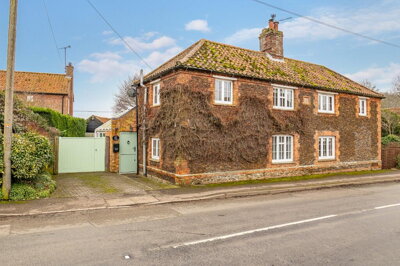
Browse 1 home for sale in Flitcham with Appleton from local estate agents.
Three bedroom properties represent a significant portion of the Flitcham With Appleton housing market, offering space for families with multiple reception rooms and gardens in many cases. Browse detached, semi-detached, and terraced options ranging from period character homes to contemporary developments.
The Flitcham with Appleton property market reflects its position as a mid-tier parish within King's Lynn and West Norfolk, currently ranked 27th most expensive out of 85 parishes with adequate sales activity since 2018. Our data shows the average house price stands at £405,000 over the last year, representing a 9.2% decrease compared to the previous twelve months. This follows a more significant 25% decline from the prior year, with prices now 57% below the 2010 peak of £946,000. These figures suggest a market that has experienced correction but may present value opportunities for long-term buyers.
Property type data specific to Flitcham with Appleton remains limited, though historical sales records indicate semi-detached properties have sold between £137,500 and £265,000 depending on size, location, and condition. A semi-detached house on Hillington Road, Flitcham, sold for £180,000 in February 2014, having previously achieved £175,000 in April 2011 and £137,500 in June 2009. Another semi-detached property at 62 Poppy Lodge on Church Road sold for £265,000 in August 2001, demonstrating how values have evolved over time in this specific postcode area.
No active new-build developments were identified within the PE31 postcode area, meaning buyers seeking modern accommodation may need to consider surrounding villages or accept that stock comprises predominantly older properties. The limited sales volume typical of small rural parishes means each transaction can significantly influence average prices, making individual property assessments essential. Given the historical nature of much of the housing stock, including properties dating from various periods of Norfolk's building history, prospective buyers should factor in potential renovation costs and the requirements of older construction methods when evaluating properties.

Flitcham with Appleton offers a quintessentially English rural lifestyle rooted in centuries of agricultural tradition and aristocratic heritage. The area has been a farming area since Roman times, with the landscape shaped by centuries of cultivation and rural settlement. Population figures show a modest decline from 276 residents in 2011 to 260 in the 2021 census, suggesting relative stability in this tight-knit community. The estimated population for June 2024 stands at approximately 255, maintaining the parish's intimate scale.
The natural environment around Flitcham with Appleton provides ample recreational opportunities for residents. The River Babingley flows through the parish, supporting local wildlife and offering pleasant walking routes through countryside that has remained largely unchanged for generations. Heritage sites including the Grade II* listed ruined Church of St Mary at Appleton, dating from at least the 11th century, and the scheduled medieval settlement at Flitcham Priory provide fascinating historical interest. The presence of a Roman villa site near Denbeck Wood underscores the long-standing human habitation of this area. For families and individuals seeking an escape from urban pressures, the village delivers an authentic Norfolk countryside experience.
The area's connection to the Sandringham Estate places it within one of Britain's most significant royal landscapes, adding prestige and maintaining the traditional character that defines village life here. Local amenities in surrounding villages and the market town of King's Lynn, approximately 8 miles southwest, provide practical necessities including shops, healthcare facilities, and recreational options. The village itself maintains its agricultural heritage, with working farms continuing to shape the landscape and contribute to the local economy. Community events and local traditions continue to bind residents together, creating a genuine sense of belonging despite the small population.
Properties in Flitcham with Appleton reflect the historical building traditions of Norfolk, using materials including clunch, Sandringham stone, carstone, flint, and brick. The ruined 11th-century Church of St Mary demonstrates these local materials in its construction, incorporating Roman tiles from nearby settlements. Historically, properties in the wider Norfolk area were built with distinctive Norfolk white brick or red brick, and often had solid walls without damp-proof courses or cavity insulation. The Flitcham War Memorial, constructed of stone and slate, exemplifies the traditional materials found throughout the parish. Understanding these construction methods is essential when assessing properties, particularly for renovation planning or when commissioning surveys.
Given the presence of older properties and traditional building materials, common defects in Flitcham with Appleton properties include rising damp, failed pointing, and settlement cracking. Older properties typically feature solid-walled construction without modern cavity insulation, which affects thermal performance and moisture management. Our inspectors frequently identify issues with damp penetration through solid walls, deterioration of traditional lime mortar pointing, and signs of historic settlement in properties built on variable ground conditions. The presence of clay in the wider Norfolk region suggests potential for shrink-swell movement in ground conditions, which can manifest as cracking in walls and movement in foundations over time.
Flitcham lies along the course of the River Babingley, creating flood risk considerations for properties near watercourses or in lower-lying positions. While specific flood risk maps for individual properties were not available, environmental searches during conveyancing will identify whether a property falls within flood zones. Our surveyors assess visible signs of damp, water staining, and moisture damage that may indicate historical flooding or ongoing water penetration issues. Electrical wiring in older properties often requires assessment, as many pre-1919 properties will have original or aging electrical systems that do not meet current standards. A RICS Level 2 survey provides detailed inspection of these common defect areas, giving buyers a comprehensive understanding of condition before committing to purchase.
Families considering Flitcham with Appleton will find a selection of educational options within reasonable driving distance. The village's small population means local primary schooling typically relies on nearby villages and the surrounding market towns. Snettisham Primary School serves the local area and has earned recognition for its community-focused education, while other nearby villages host their own primary schools catering to surrounding communities. King's Lynn, approximately 20 minutes by car, hosts several primary schools serving the wider area alongside secondary schools including King Edward VII School, a well-established secondary with strong academic provision.
Parents should research specific catchment areas and admission policies, as rural school placement can be competitive during peak enrollment periods. The geography of West Norfolk means school transport arrangements form an important consideration when evaluating properties in Flitcham with Appleton. Many families choose to settle with this logistical factor clearly planned, particularly for secondary school pupils requiring daily transportation to more distant institutions. Schools in the surrounding villages typically operate catchment areas that may include properties in Flitcham with Appleton, and parents are advised to confirm arrangements with Norfolk County Council's education department before committing to a property purchase.
For older students, secondary education options expand further afield, with grammar schools and comprehensive schools available across West Norfolk. The historic town of King's Lynn provides further education facilities at colleges serving students from Year 12 onwards, offering vocational and academic pathways. Springwood High School in King's Lynn and St Peter's School in the town offer comprehensive secondary education, while King's Lynn Grammar School provides an academic selective option for eligible students. Transport to these facilities typically requires private vehicle arrangements, reinforcing the importance of car ownership for families in this rural parish.

Transport connectivity from Flitcham with Appleton reflects its rural Norfolk location, with private vehicles remaining the primary means of daily travel for most residents. The village sits approximately 8 miles northeast of King's Lynn, the nearest major town providing comprehensive retail, healthcare, and employment opportunities. Road access connects the parish to the A148 and subsequently the A47, facilitating travel east towards Norwich and west towards Peterborough and the A1. Journey times to Norwich typically take around 45 minutes under normal traffic conditions, making day trips feasible though daily commuting challenging.
Public transport options for Flitcham with Appleton residents are limited, as expected for a small rural parish. Bus services connecting to King's Lynn operate on reduced frequencies compared to urban routes, making car ownership effectively essential for most residents. The Coastliner bus service provides connections along the A148 corridor, linking coastal villages with King's Lynn and offering an alternative to private vehicle travel for those with flexible schedules. King's Lynn railway station provides connections to Cambridge and Norwich, with onward links to London via Peterborough or Norwich to London Liverpool Street.
For commuters prepared to factor in journey times and accept a car-plus-train approach, employment in Cambridge or Norwich remains achievable on a regular basis. Cambridge is approximately 50 miles south via the A10 or through King's Lynn station, while Norwich lies around 35 miles east via the A47. Both cities offer significant employment opportunities across sectors including technology, healthcare, and education. The peaceful rural setting comes with this trade-off in accessibility, and prospective residents should carefully consider whether their employment circumstances align with Flitcham with Appleton's connectivity before committing to a move.
Start by exploring current property listings in Flitcham with Appleton and surrounding villages on Homemove. Understanding price trends, property types available, and typical time on market helps set realistic expectations for your search. Given the limited sales volume in this small parish, properties rarely appear in high volumes, so regular monitoring of listings is advisable. The area's position within the Sandringham Estate corridor and its heritage status may influence property availability and pricing dynamics compared to standard rural locations.
Before arranging viewings, contact lenders to obtain a mortgage agreement in principle. Having this documentation strengthens your position when making offers and demonstrates you are a serious buyer with financing in place. With average prices around £405,000, most buyers will require mortgage financing rather than cash purchases. Rural properties sometimes present challenges for lenders due to non-standard construction or listed status, so discussing your intended property type with a broker experienced in Norfolk rural properties is advisable before committing to a specific mortgage product.
Visit properties that match your criteria, taking time to assess the property's condition, surroundings, and proximity to local amenities. For older properties in this area, pay particular attention to building materials, potential maintenance needs, and the implications of listed status. Properties may feature solid walls, traditional Norfolk construction methods, and materials such as clunch or carstone that differ from modern building standards. Take notes and photographs during viewings to help compare properties and identify potential concerns requiring further investigation.
Once you have a property under offer, arrange a Level 2 survey to assess the condition of the property. Given the age of housing stock in Flitcham with Appleton, including many pre-1919 properties built with traditional Norfolk materials, this survey provides essential information about potential defects including damp, structural issues, and repair requirements. Pre-1900 properties may incur additional survey fees due to their complexity, but the investment provides crucial information for negotiating repairs or price adjustments before completion.
Appoint a solicitor to handle the legal aspects of your purchase, including local searches, title verification, and contract exchange. Choose a conveyancer experienced with rural Norfolk properties and any specific issues related to conservation areas or listed buildings. Local searches will reveal information about flood risk areas, scheduled monuments, and environmental considerations specific to Flitcham with Appleton's geography along the River Babingley. The solicitor will also handle land registry submissions, stamp duty calculations, and funds transfer on completion.
Once all legal requirements are satisfied and financing confirmed, proceed to contract exchange with an agreed completion date. On completion day, your solicitor transfers funds and you receive the keys to your new Flitcham with Appleton home. Allow time for final property inspection before completion where possible, checking that agreed repairs have been completed and no new issues have arisen since the survey.
Purchasing property in Flitcham with Appleton requires attention to several area-specific factors that may not apply to urban homes. The significant heritage status of the parish means many properties sit within or near conservation considerations, and several buildings carry listed status ranging from Grade II to Grade II*. The Grade II* listed Church of St Mary at Appleton demonstrates the level of heritage designation present, while the Flitcham War Memorial and K6 Telephone Kiosk hold Grade II listing. Buyers must understand that listed building consent may be required for alterations, and standard renovation approaches might face restrictions.
Scheduled ancient monuments on and around various properties could affect permitted development rights and future plans. Sites including the bowl barrow and moot on Anmer Minque, Appleton medieval settlement, the moated site south of St Mary's church, Flitcham Priory, and the Roman villa in Denbeck Wood all carry scheduled status. Properties near these monuments may face restrictions on ground works, landscaping, or construction that would otherwise be permitted development. A solicitor's local search will reveal any scheduled monument considerations affecting a specific property.
Flood risk deserves careful consideration given Flitcham's position along the River Babingley. While specific flood mapping for the parish was not detailed in available research, the low-lying nature of parts of Norfolk generally means buyers should investigate flood risk for any specific property, particularly those near watercourses or in lower-lying ground. Survey reports will typically flag any visible signs of damp or water damage, but comprehensive flood risk assessment requires separate environmental searches. Properties in this area were historically built with solid walls rather than cavity construction, which affects insulation performance and moisture management, another factor highlighted by detailed surveys.
Building materials throughout the parish reflect Norfolk's geological diversity, including clunch, Sandringham stone, carstone, flint, and brick. The presence of these materials in older properties means renovation work may require specialist contractors familiar with traditional building methods. Properties may have solid walls lacking modern damp-proof courses, original lime mortar pointing that has deteriorated over time, and timber elements susceptible to rot or woodworm. A thorough survey will identify these issues and their implications for ongoing maintenance and renovation costs.
The average house price in Flitcham with Appleton currently stands at £405,000 based on sales over the last year. This represents a 9.2% decrease compared to the previous twelve months and follows a 25% decline from the prior year. The parish ranks as the 27th most expensive out of 85 parishes in King's Lynn and West Norfolk. Prices have fallen significantly from the 2010 peak of £946,000, suggesting the market may offer value for buyers with longer-term investment horizons. Individual property prices vary considerably based on type, size, condition, and specific location within the parish, with semi-detached properties historically selling between £137,500 and £265,000 depending on the specific property and sale date.
Properties in Flitcham with Appleton fall under the council tax jurisdiction of King's Lynn and West Norfolk Borough Council. Specific band allocations depend on the assessed value of individual properties, with rural Norfolk properties typically spanning bands A through E. The parish's mix of older cottages, farmhouses, and modernised period properties means council tax bands will vary accordingly across the housing stock. Buyers should verify the council tax band for any specific property through the local authority website or property information provided during the conveyancing process. Annual council tax charges can be confirmed once a purchase is completed, and prospective buyers should factor these ongoing costs into their budget calculations alongside mortgage payments and maintenance expenses.
Flitcham with Appleton's small population means families typically access primary education in surrounding villages or nearby towns. Snettisham Primary School serves the local area, while King's Lynn hosts several primary and secondary schools including King Edward VII School, providing strong academic options within reasonable driving distance. Parents should research individual school Ofsted ratings and admission catchment areas, as placement in rural Norfolk can be competitive during peak enrollment periods. For secondary education, grammar schools and comprehensives across West Norfolk serve the wider area, with transport arrangements forming an important consideration for daily school attendance from this rural parish.
Public transport connectivity from Flitcham with Appleton is limited, reflecting its status as a small rural parish. Bus services connecting to King's Lynn operate infrequently, making private vehicle ownership effectively essential for most residents. The Coastliner service provides connections along the A148 corridor, but frequencies are reduced compared to urban routes. King's Lynn railway station provides connections to Cambridge and Norwich, with onward services to London from both Peterborough and Norwich. Daily commuting to major employment centres requires careful planning and acceptance of multi-modal journey approaches combining car and rail travel.
Flitcham with Appleton offers distinct investment characteristics shaped by its rural location and heritage status. The 9.2% price decrease over the past year indicates a market in adjustment, though the 57% decline from the 2010 peak suggests significant correction has already occurred. Properties in rural Norfolk villages with royal estate connections maintain appeal for certain buyer segments, and the Sandringham Estate proximity adds prestige to the location. However, limited local employment, restricted transport options, and the small scale of the community mean capital growth potential may be more modest compared to urban or commuter-belt locations. Buyers seeking countryside tranquility and heritage character rather than investment returns will find the area most suitable.
Stamp duty Land Tax applies to purchases in Flitcham with Appleton according to standard UK thresholds. For properties purchased after October 2024, buyers pay 0% on the first £250,000, 5% on £250,001 to £925,000, 10% on £925,001 to £1.5 million, and 12% above £1.5 million. First-time buyers benefit from relief on the first £425,000, with 5% charged between £425,001 and £625,000. Given the average price of £405,000, most standard purchases would attract stamp duty charges of approximately £7,750 for non-first-time buyers, or potentially no stamp duty for qualifying first-time purchasers.
Properties in Flitcham with Appleton reflect the historical building traditions of Norfolk, using materials including clunch, Sandringham stone, carstone, flint, and brick. The ruined 11th-century Church of St Mary demonstrates these local materials in its construction, incorporating Roman tiles from nearby villa settlements. Older properties typically feature solid-walled construction without modern cavity insulation, which affects thermal performance and moisture management. Understanding these construction methods is important when assessing properties, particularly for renovation planning or when commissioning surveys that account for non-standard construction types common in heritage properties.
Flitcham with Appleton sits along the course of the River Babingley, creating flood risk considerations for properties near the watercourse or in lower-lying positions within the parish. Flood risk is a general environmental concern in low-lying parts of Norfolk, and environmental searches during conveyancing will identify whether a specific property falls within designated flood zones. Our surveyors assess visible signs of damp, water staining, and moisture damage that may indicate historical flooding or ongoing water penetration issues. Buyers should consider both the property's position relative to the river and the general drainage characteristics of the land when evaluating properties in this riverside parish.
Given the prevalence of older properties and traditional construction methods in Flitcham with Appleton, a RICS Level 2 survey is recommended for most purchases to assess condition and identify defects. Pre-1900 properties may require a RICS Level 3 Building Survey for comprehensive structural assessment due to their complexity and non-standard construction. Common issues identified in older Norfolk properties include rising damp through solid walls, deterioration of traditional lime mortar pointing, settlement cracking, and timber defects. The survey cost for properties in Norfolk typically ranges from £375 for standard properties, with additional fees applying for larger, older, or non-standard construction properties.
From £375
A detailed assessment of property condition, ideal for Flitcham with Appleton's mix of period properties
From £600
Comprehensive structural survey recommended for older or non-standard properties
From £499
Legal services for your property purchase, including local searches
From 3.8%
Finance your Flitcham with Appleton property purchase
Budgeting for stamp duty forms a significant part of purchasing costs for any property in Flitcham with Appleton. With the average property priced around £405,000, standard rate buyers would calculate stamp duty on the portion above £250,000. This results in charges of approximately £7,750 at current rates. First-time buyers purchasing residential properties up to £425,000 qualify for complete relief on the first £425,000, meaning qualifying first-time purchasers of average-priced properties in this parish would pay no stamp duty at all. Those purchasing between £425,001 and £625,000 face a 5% charge on the amount exceeding £425,000.
Beyond stamp duty, buyers should budget for survey costs, with RICS Level 2 surveys in Norfolk averaging around £498.95 and starting from approximately £375 for standard properties. Given the age and character of housing stock in Flitcham with Appleton, including many pre-1919 properties built with traditional Norfolk materials, additional survey fees may apply for non-standard construction or older properties requiring more detailed assessment. Pre-1900 properties can incur an additional 20-40% cost due to their complexity, while non-standard construction materials may add a further 15-30%.
Conveyancing costs typically start from £499 for standard transactions, with search fees and Land Registry charges adding further amounts. Local searches for Flitcham with Appleton will include drainage and water searches, environmental searches addressing flood risk along the River Babingley, and mining searches if applicable. Combined, these costs typically total £3,000 to £5,000 depending on property price and complexity. Obtaining a mortgage agreement in principle before beginning your property search strengthens your position and clarifies your realistic budget for this attractive Norfolk village.
Properties for Sale In London

Properties for Sale In Plymouth

Properties for Sale In Liverpool

Properties for Sale In Glasgow

Properties for Sale In Sheffield

Properties for Sale In Edinburgh

Properties for Sale In Coventry

Properties for Sale In Bradford

Properties for Sale In Manchester

Properties for Sale In Birmingham

Properties for Sale In Bristol

Properties for Sale In Oxford

Properties for Sale In Leicester

Properties for Sale In Newcastle

Properties for Sale In Leeds

Properties for Sale In Southampton

Properties for Sale In Cardiff

Properties for Sale In Nottingham

Properties for Sale In Norwich

Properties for Sale In Brighton

Properties for Sale In Derby

Properties for Sale In Portsmouth

Properties for Sale In Northampton

Properties for Sale In Milton Keynes

Properties for Sale In Bournemouth

Properties for Sale In Bolton

Properties for Sale In Swansea

Properties for Sale In Swindon

Properties for Sale In Peterborough

Properties for Sale In Wolverhampton

Enter your details to see if this property is within your budget.
Loans, cards, car finance
Estimated property budget
Borrowing + deposit
You could borrow between
Typical borrowing
Monthly repayment
Est. at 4.5%
Loan-to-value
This is an estimate only. Your actual budget may vary depending on interest rates, credit history, and personal circumstances. For an accurate affordability assessment, speak to one of our free mortgage advisors.
This calculator provides estimates for illustrative purposes only and does not constitute financial advice. Your home may be repossessed if you do not keep up repayments on your mortgage. Estimates based on 4.5% interest rate, repayment mortgage. Actual rates depend on your circumstances.
Homemove is a trading name of HM Haus Group Ltd (Company No. 13873779, registered in England & Wales). Homemove Mortgages Ltd (Company No. 15947693) is an Appointed Representative of TMG Direct Limited, trading as TMG Mortgage Network, which is authorised and regulated by the Financial Conduct Authority (FRN 786245). Homemove Mortgages Ltd is entered on the FCA Register as an Appointed Representative (FRN 1022429). You can check registrations at NewRegister or by calling 0800 111 6768.

We use cookies to show you personalised content and improve your experience of our website. Find out more in our Privacy policy and Cookie policy.